Don Ritter //

braskartIMO

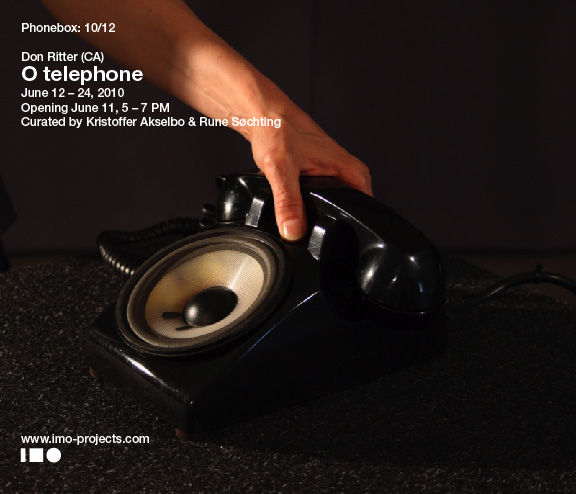
Canadian artist Don Ritter presents his work O telephone in the exhibition space Phonebox at the artist-run gallery IMO. Phonebox is located in a phone cabin, which now serves as an intimate exhibition space with room for only one person at a time. Here the public is invited to experience the sound work O telephone June 12 – June 24.
The sound composition O telephone is based on an interactive installation Ritter created in 2007. In the piece a number of modified telephones from the 60’s were connected in series and placed in a circle. When the audience lifted the handset the telephone generated a loud Om sound. The sound from the different telephones created a sound composition. Om is a sacred syllable within various Indian religions, including Hinduism, Jainism, and Buddhism. The various meanings of Om include the sound of existence, the sound of the universe, and the sound that contains all other sounds. In the sound work O telephone presented in Phonebox Ritter works with recordings of the Om sounds that serve as material for a composition.

A road with heavy traffic as an interactive sound-scene with build-in accidents, a speaker’s podium in front of a loud virtual crowd, a TV that reacts to the viewer. In his work, Canadian artist and writer Don Ritter investigates mass communication and technology through staging interactive scenarios where the audience is at the centre of things. Sound and image are central components that are used to great effect in works that investigate social themes such as hegemony, servility, mechanisms of authority and commodification of human tragedy. Ritter’s background is diverse. He has degrees in Fine Arts and Psychology and Electronics Engineering Technology and a Master in Visual Studies. He has worked as a designer/researcher for Northern Telecom and Bell-Northern Research.
Don Ritter’s work is the tenth in a series of 12 sound-based works presented in Phonebox at IMO in the first half of 2010. The series is titled Sounds Up Close #1-12 and is curated by Kristoffer Akselbo and Rune Søchting. It is the intention of the series to present a number of important artists who work with sound as medium. The series reflects a variety of different approaches to sound. Over a period of six months a total of twelve pieces will be presented each for a fortnight. Up-coming artists in Phonebox are Steve Roden (US) and Miki Yui (JP).

Phonebox has earlier served as a phone cabin for the employees at Carlsberg. During the next six months the space, which is acoustically isolated, will function as a unique frame for display and reception of sound-based works. Moreover, the space itself will play an important role in the conceptions of many of the presented works.
IMO

Morten Skrøder Lund

braskartblog

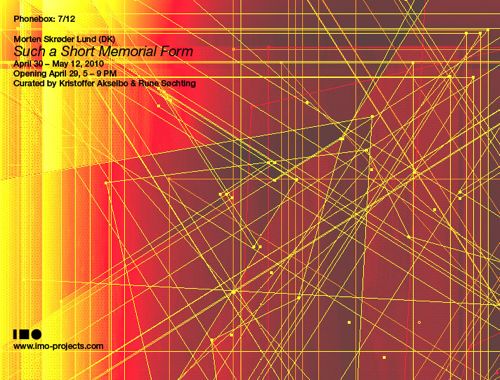
Danish artist Morten Skrøder Lund presents a brand new work titled Such a Short Memorial Form in the exhibition space Phonebox at the artist-run gallery IMO. Phonebox is located in a former phone cabin, which will serve as an intimate exhibition space with room for only one person at a time. Here the public is invited to experience the sound work Such a Short Memorial Form April 30 – May 12.

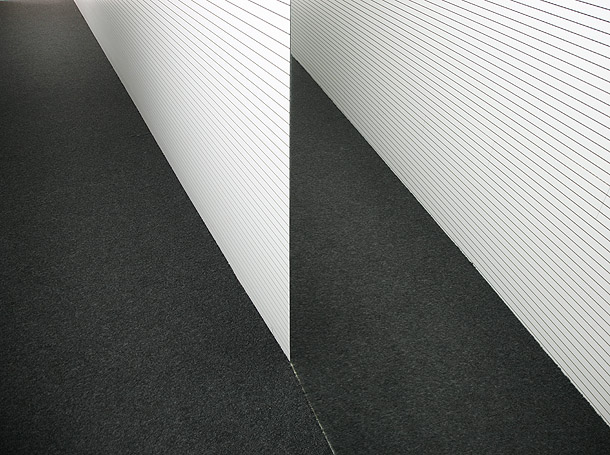
In his new work Such a Short Memorial Form created for IMO’s Phonebox, Morten Skrøder Lund works with how a space acoustically can be represented and displaced. The work unfolds both auditorily and visually by use of microphones and speakers as primary components. Sound from the gallery space outside the acoustically isolated phone cabin is captured with microphones and is heard displaced and distorted inside the phone cabin. The idea of the cabin as a sound-proof private space and the walls as stable architectural borders are challenged. The spatial displacement is further enhanced by the visual elements of the work where the magnetic field that exists around a loudspeaker is used to create a floating sculptural structure.

Morten Skrøder Lund is a young Danish artist, graduated from the Royal Danish Academy of Art in Copenhagen. He works in various formats such as painting and installation and often integrates sound as an active element in his works. He is active as a musician with special attention to experiments with electronic sound and phenomena such as feedback. His approach to the sonic medium is spatial and sculptural. Especially the idea of sound as a physical event is at the centre of his work where sound as a process literally sets material in motion. And through this motion creates relations between objects, materials and people.

Morten Skrøder Lund’s work is the seventh in a series of sound-based works presented in Phonebox at IMO in the first half of 2010. The series is titled Sounds Up Close #1-12 and is curated by Kristoffer Akselbo and Rune Søchting. It is the intention of the series to present a number of important artists who work with sound as a medium. The different pieces reflect a variety of approaches to the work with sound as medium. Over a period of six months a total of twelve pieces will be presented each for a fortnight. Some of the up-coming artists in Phonebox are Dani Gal (IL), Steve Roden (US) and Marc Behrens (DE).

Phonebox has earlier served as a phone cabin for the employees at Carlsberg. During the next six months the space, which is acoustically isolated, will function as a unique frame for display and reception of sound-based works. Moreover, the space itself will play an important role in the conceptions of many of the presented works.
IMO

Torben Ribe // Dust, Kiwi & Rucola

braskart

Abstract painting is unreal. It does not resemble anything in particular. But it happens the same goes for a slice of the world. And it is such slices – such ”found abstractions” – that Torben Ribe indulges in and stages.

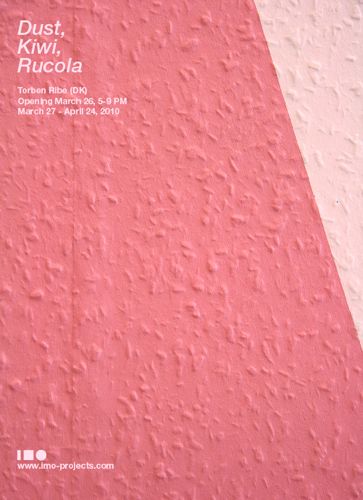
His first solo exhibition Dust, Kiwi, Rucola at IMO is an environment built around a series of fictive wall sections hung directly upon the walls as paintings. The artist puts himself in the place of the creative handyman and bricoleur. His paintings – reminiscent of assemblages – convey homely do-it-yourself activities. They recall attemps at home at decorating and patching-up, attempts at patching-up decorations and decorative attemps at patching-up patch-ups. In the process various fixtures and electrical components have been mounted on the paintings oblivious of their intended purposes and thus serving purely compositional ends. Here you find ventilation shafts without air passage, lamps that are not lit, handles that neither close nor open anything and leads which lead nowhere.

With his news series of works Torben Ribe reconsiders painting as ”a portrait of a situation.” Every work recounts a story of a deadlock, where every solution to an asthetic and pratical problem results in yet a problem, which asks for yet a solution:
One painting is made up of a section of kitchen tiles in various colors which have been painted over with white paint. The paint does not cover neatly, so the colors of the tiles show through as pastels. Another painting consists of a wall decorated in a non-figurative manner, but the wall is damaged by damp. A ventilator has been added, but is askew on the wall though even with the diagonals of the abstract wall painting.

The exhibition is the result of long-time research into how people creatively arrange and express themselves in their home and everyday life. The works spring from meditations on various surface treatments, different color charts, interior design and more.

The exhibition title refers to three colors, i.e. creamy gray, pastel green and dark green. One paint company has named the colors respectively ’dust’, ’kiwi’ and ’rucola’ – another paint company ‘think!’, ‘mineral’ and ‘silk road’. The names are completely different though the colors are not. The discrepancy intrigues Torben Ribe: “It is difficult to invent new colors. Colors are somewhat invariable, but at different times in history they trigger different associations. The names and meanings of colors constantly change depending on the fashion of the moment within art, design and lifestyle. What colors and abstract painting have in common is that they both serve as projection screen for people’s thoughts, feelings, needs and desires. Colors – just like abstract painting – leave room for the spectator.”

Torben Ribe (1978, DK) has a Master of Fine Arts from the Royal Danish Academy of Fine Arts. He has been nominated to the Carnegie Art Award, which can be seen this year at National Gallery of Iceland, Reykjavik, Royal Academy of Fine Arts, Stockholm, Kunstnernes Hus, Oslo, 789 Art Space, Beijing, and Royal College of Art, London. In May he opens his first solo exhibition in Germany at BN 24, Hamburg.

IMO

Torben Ribe

Ursula Nistrup

braskart

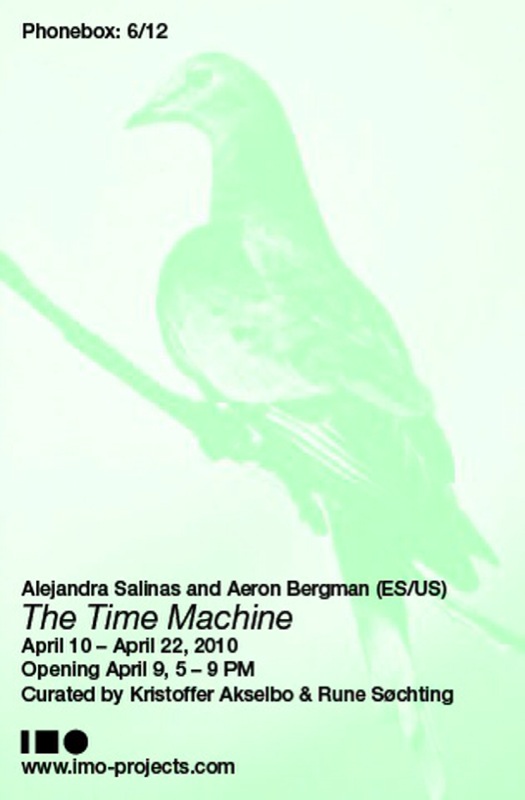
Ursula Nistrup presents a brand new work entitled On the moods of sound over the Bosphorus Strait, Istanbul, Turkey. The sound work is produced for the exhibition space Phonebox at the artist-run gallery IMO. Phonebox is located in a former phone cabin, which will serve as an intimate exhibition space with room for only one person at a time. Here the public is invited to experience the sound work On the moods of sound over the Bosphorus Strait Istandbul, Turkey from January 29 – February 10.

Taking photography and architecture as a starting point, Ursula Nistrup examines the relationship between space and spatial representations, in particular the relationship between sound and space. Her new work On the moods of sound over the Bosphorus Strait, Istanbul, Turkey is based on recordings of horn from ships that daily maneuver the Bosphorus Strait. The multiplicity and tonality of the horns evoke the sound from the orchestra pit in a concert hall before the beginning of the concert. The motif of a unique and unintended “concert” emerges and with it the question of the relation between space and listener. Ursula Nistrup has studied at Glasgow School of Art (MFA) and CalArts.

Ursula Nistrup’s work is the second in a series of sound-based works presented in Phonebox at IMO in the first half of 2010. The series is titled Sounds Up Close #1-12 and is curated by Kristoffer Akselbo and Rune Søchting. It is the intention to present a number of important artists who work with sound as a medium. The different pieces reflect a broad variety of approaches to the work with sound as medium. Over a period of six months a total of twelve pieces will be presented, each for a fortnight. Some of the up-coming artists in Phonebox are Alejandra and Aeron (ES/US),  Ultra-red (US) and Jio Shimizu (JP).

Phonebox has earlier served as a phone cabin for the employees at Carlsberg. During the next six months the space, which is acoustically isolated, will function as a unique frame for display and reception of sound-based works. Moreover, the space itself will play an important role in the conceptions of many of the presented works.
IMO