Tag: New York
BILL JENSEN
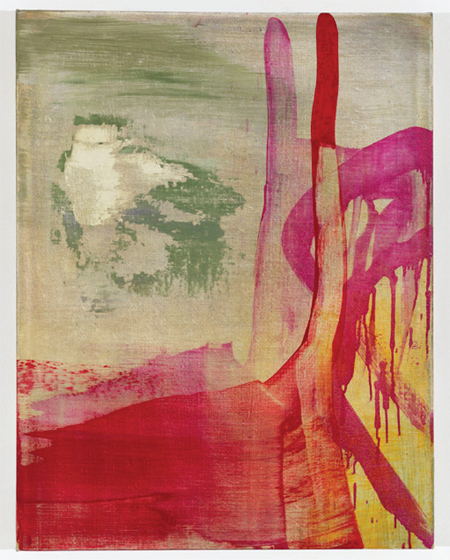
Cheim & Read is pleased to announce an exhibition of paintings and works on paper by Bill Jensen. The show is accompanied by a full-color catalogue with an essay by David Hinton, a prominent scholar and respected translator of Chinese poetry. This is Jensen’s second show with the gallery; his first was in 2007.
Bill Jensen was born in Minneapolis, Minnesota in 1945 and received his MFA at the University of Minnesota in 1970. He has lived and worked in New York since the early 1970s, maintaining a studio in Williamsburg, Brooklyn. Jensen has long been respected for his unconventional abstractions, their compositions evocative of otherworldly landscapes where spatial definition is informed by structural logic. Shape, line, and intense color follow unpredictable paths, but coexist in psychic harmony. Influence of the early American modernists (Albert Pinkham Ryder, Arthur Dove) and the Abstract Expressionists (Jackson Pollock, Mark Rothko, the prophetic Arshile Gorky) are evident, as are the visionary canvases of Myron Stout, and Forrest Bess.
Jensen is also inspired by Taoist philosophy, Chinese painting, and ancient and contemporary Chinese poetry. The third and fourth century Taoists believed that pure nature could not be experienced by humans, due to their inevitable mannerization of the natural world. Chinese painters subsequently attempted to depict the phenomena of nature “itself.” This history, linked to the idea that all matter is the same-the understanding that something is everything and everything is something-was of profound influence on Jensen. An intuitive, unpretentious painter, Jensen strives to attain content originating in the psychic and emotional; for him, content is more important than result. Jensen argues that his paintings’ beauty, or lack thereof, is not his decision, but determined by the painting itself.
Devoted to his craft, Jensen makes his own paints with finely ground pigments and a self-developed oil-based medium. This allows him to control viscosity and saturation, and provides a wide spectrum of color and texture in his paintings. His methodology consists of multiple layering, scraping, seeping and “dredging,” and is determined in part by unusual, self-made tools. Jensen’s experimental painting techniques are pivotal to the outcome of his heavily worked canvases. As he has stated, “Solutions come from the working process.”
The recent paintings on view in this exhibition show the range of Jensen’s process and the depth of his content, from ethereal, washy forms, to dense, physically worked surfaces of color and texture, punctuated by titles like Genesis, Time After Time and Occurrence Appearing of Itself. Saturated red, blues and yellows coalesce, extending in and out of space, retreating and aggressively reappearing. The drawings and works on paper, some black and white, are more intimate in scale, but still contain the translucency and intensity of the paintings. The black and white works, with their variety of tones, read as if they were in color, while the color drawings radiate hypnotic clarity. Drawing has been a constant throughout Jensen’s practice, and was at times his main mode of artistic exploration. Its direct relationship to his painting is evident.
The sense of freedom in Jensen’s work is belied by the commitment, consistency and seriousness with which he approaches it. As he says, “Each work for me is not about one idea; it is about an emotional event that must be searched for and clarified.” Jensen achieves his goal of transforming the viewer’s experience, providing a peek into the transcendent.
Banks Violette
Gladstone Gallery, in collaboration with Team Gallery, is pleased to announce a new installation by Banks Violette. Violette’s work ranges from haunting yet exquisitely rendered graphite drawings to sculptural installations composed of cast salt, light, and sound. Throughout his practice, he plumbs the simultaneous degradation and accretion of meaning through the process of mythology, often embodied in forms strongly associated with sub-cultural communities, personal memorials, or historical obscurities. The black and white spectacle of his stark compositions belies the uneasy and fraught allusions of appropriated images and forms reconstructed as vessels of oblivion.
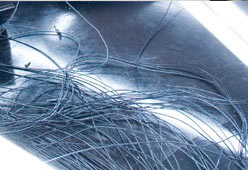
For this new installation, Violette continues to mine a rich art historical terrain in which the materials and forms associated with Minimal and Conceptual Art become reactivated as theatrical platforms of performative decay. He pairs a large chandelier composed of multiple fluorescent tubes with a black wall that seems to buckle and melt against the reflection of the light. Both aspects of the installation recall the monochromatic tone and the use of replaceable industrial materials common to Minimalist and Conceptual sculptors such as Donald Judd and Dan Flavin; however, Violette’s works seem self-consciously constructed and theatrical. Wires fall in a cascade alongside the chandelier while the apparatus of steel tubes and sandbags supporting the wall remain in plain sight. By exposing these more banal technical necessities, Violette heightens the artificial spectacle of his installation, as if willing these two canonical art historical movements into an internecine danse macabre. He unmasks form and content as sites vulnerable to intellectual vandalism and moribund mythologizing.
Banks Violette was born in 1973 and lives and works in New York. His work has been the subject of numerous solo exhibitions, including those at Museum Dhont-Dhaenens in Deurle, Belgium; Kunsthalle Wein; the Modern of Art Museum of Forth Worth, Texas; Kunsthalle Bergen, Norway; and the Whitney Museum of American Art. He has also participated in group exhibitions at The Solomon R. Guggenheim Museum, New York; the Migros Museum fur Gegenwartskunst, Zurich; Museum of Modern Art, New York; Palais de Tokyo, Paris; the Royal Academy, London; P.S. 1, New York; the Museum Boijmans van Beuningen, Rotterdam; among others.
Josh Azzarella
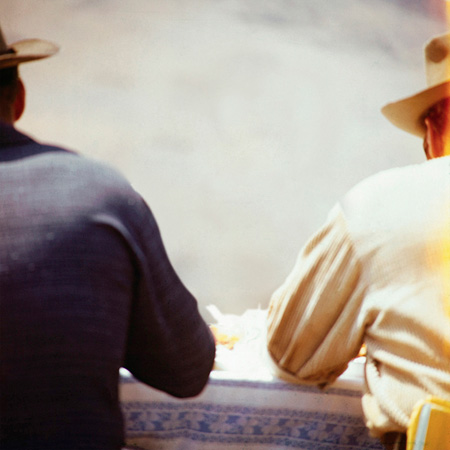
DCKT Contemporary is pleased to present new photographs by JOSH AZZARELLA. AZZARELLA manipulates images from cinema, journalism and amateur photography. His photographs muddy the waters between the artificial beauty of a cinematic set and the inherent beauty of the natural landscape. Absent their most significant events, AZZARELLA’s images raise questions about how our society constructs a narrative of our collective history.
The emptying of the photographs presents each scene in its formal beauty but leaves a ghost of its narrative past. The viewer is tempted to draw relational lines between individual photographs and to decipher patterns and groupings, taking cues from color and film grain. Movie stills, homemade images and documentary footage mix together, as in our collective memory. How individual and collective memories form, the possibilities of confusing memories with realities or creating memories where none previously existed are all key to his oeuvre.
In one photograph vines drape across branches, hearkening documentary photographs of the Vietnam War although its true source is the B movie classic Creature from the Black Lagoon. Emptied seascapes recall the stillness of Hiroshi Sugimoto photographs. The backs of two men on an Elvis Presley film set evoke 1960s family photographs, perhaps of a picnic.
AZZARELLA lives and works in New York City. Solo and group exhibitions include Mark Moore Gallery (Santa Monica, CA); Vancouver Art Gallery (British Columbia); Kavi Gupta Gallery (Chicago); Akademie der Künste (Berlin). He was the recipient of the 2006 Emerging Artist Award and a solo exhibition from The Aldrich Contemporary Art Museum (Ridgefield, CT). His work is included in the permanent collection of the San Francisco Museum of Modern Art. This is his third solo exhibition with DCKT Contemporary.
John Copeland
Marcia Hafif @ Newman Popiashvili Gallery
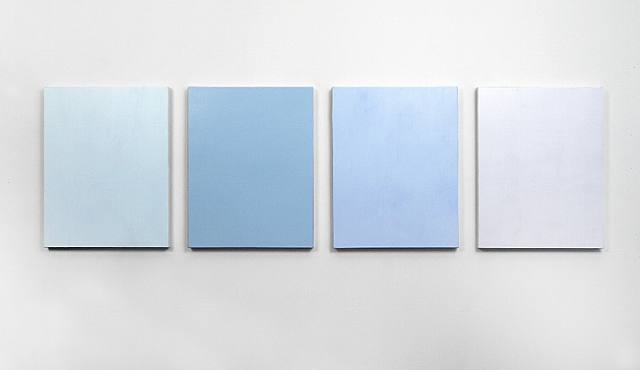
Newman Popiashvili Gallery is pleased to present a solo exhibition of Marcia Hafif. The gallery will be showing historic works – the Black Paintings from 1979-80 that were originally shown at Sonnabend gallery in 1981. Although Hafif has shown extensively in Europe and in the US for the past fifty years, this exhibition offers a rare opportunity for another look at Hafif’s early monochromes thirty years later.
Marcia Hafif published an article in Artforum magazine in 1978 titled “Beginning Again,” a catalyst for gathering artists under the title Radical Painting, which was the name of an exhibition curated by Thomas Krens at Williams College in 1984. The artists who were part of Radical Painting advocated a certain fundamentalism in painting – a stance that found more favor in France, Germany, Austria and Switzerland, than in New York. Hafif wrote that “although [her monochromes] may have an undivided surface,” they were “not merely of one color in one undifferentiated plane, each painted exactly like another.” The four paintings in the exhibition are composed of Burnt Umber and Ultramarine Blue pigments. The closer we look, the more dissimilarities we see among them, and a certain imagery appears in each.
Marcia Hafif always underlined the “prime importance” of the hanging of a monochromatic painting – “A monochromatic painting does not hold a tight focus in that its own energy spreads out to areas surrounding it, which is one of the reasons why walls today are white or neutral avoiding the color harmony automatically set up between the painting and a wall color.”
Notwithstanding their history, these paintings offer us a powerful viewing experience.
At the age of eighty, Hafif continues to work between New York City and Laguna Beach, CA. Her most recent show opened in November 2009 at Kunstraum Alexander-Buerkle, Freiburg, Germany and she is scheduled for a show at MAMCO, Geneva in April that coincides with the publication of a catalogue raisonné of her Italian paintings painted in Rome, Italy 1961-69.
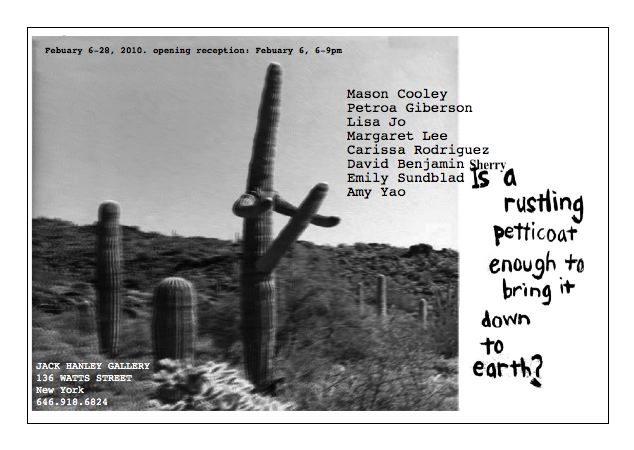
Is a Rusted Petticoat Enough to Bring it Down to Earth?
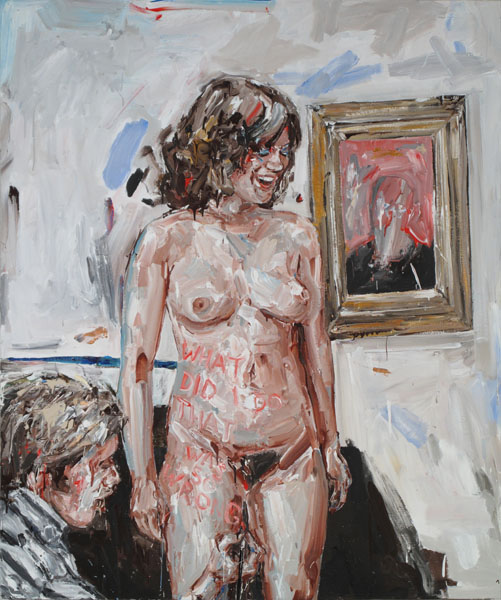
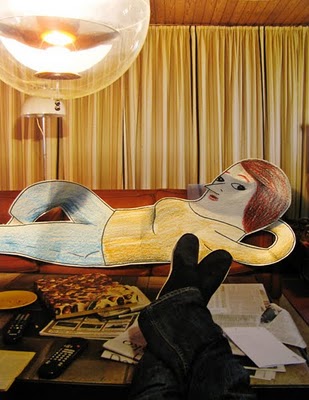
Portrait of a Lady @ LaViola Gallery
Gert & Uwe Tobias
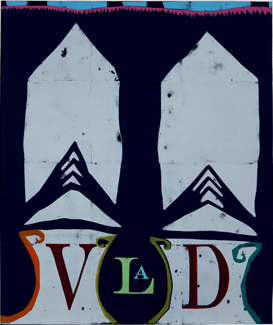
Gert & Uwe Tobias
Come and See Before the Tourists Will Do – The Mystery of Transylvania
Team is pleased to present an exhibition of new work by the Köln-based brothers Gert & Uwe Tobias. Entitled Come and See Before the Tourists Will Do – The Mystery of Transylvania, the exhibition will run from the 11th of February through the 13th of March 2010. Team Gallery is located at 83 Grand Street, cross streets Wooster and Greene, on the ground floor.
To date, the biographical details surrounding Gert & Uwe Tobias have been used as an entry point to their sophisticated, ultra-stylized and, at times, darkly humorous installations, which, through their incorporation of wall painting, watercolors, collages, vitrines containing altered books, type-writer drawings, ceramic sculptures, and large-scale wood cut prints frequently approach the status of the gesamkunstwerk. The fact that they are identical twin brothers, for example, seems to provide an insight into the fact that their primary mode of production is that of printmaking and that these works are produced in hand-made editions of two – never exactly the same but always alike. Much has also been made of their birth in the region of Transylvania, Romania, as though this fact makes it appropriate that they began their careers with a body of work inspired by (among other things) low-budget vampire movies. This biographical data, however, only provides a cursory introduction to an artistic practice that encompasses an ever-widening range of influences and intentions.
The title of this show, Come and See Before the Tourists Will Do – The Mystery of Transylvania, was initially used by the Brothers in 2004 as an umbrella for a body of work that could have served to advertise horror films had those filmmakers commissioned neo-constructivists to promote their fictions. The Brothers chose from a list of titles of American and British films about vampires. These titles were then used as the inspiration for a group of sumptuously rendered, vividly colored wood block prints. These large-scale “posters” – at the same time conservative, modernist artworks and knowing commentaries on the commerce of art making – enjoyed a status as rarified art objects that culled from sources as far ranging as the Bauhaus, vintage fashion magazines, travel posters, and fabric designs. The Tobias Brothers’ vampire posters were, to put it mildly, virtuosic displays of historical knowledge. In 2009, Gert and Uwe decided to return to the series, this time focusing on European horror films, leaving their titles in the source languages. The results will line the walls of Team’s main gallery space.
The Tobias’ introspective and oblique woodcuts lovingly embrace eccentric figuration, geometric abstraction, and the typographic. Presented with them are a series of collages made from cutting and recombining books and other printed matter. These collage/sculptures are shown inside two large-scale vitrines that occupy the center of the space, while Team’s second gallery will contain the “exhibition woodcut.” For each of their solos, the Brothers create a print that functions both as an autonomous artwork and as a promotional tool for the show itself. Surrounding this piece will be a number of drawings made by Gert and Uwe using typewriters and white sheets of paper.
The Tobias’ interest in folklore and regional mythologies provides a contextual framework for their exhibitions. Personal biography, cultural identity, and popular culture all play a role in their creation of an open ended visual dialect. They borrow freely from art historical and other cultural milieus in order to construct a fragmented array of material tropes, which are then subsumed into a whole through a precisely considered exhibition schema.
The Tobias Brothers have had solo exhibitions in the US at the Museum of Modern Art in New York and at the Hammer Museum in Los Angeles. Additionally, solo shows have been mounted by the Kunstmuseum in Bonn, the Bergen Kunsthall in Norway, the Kunstverein in Heilbronn, the Kunsthalle Wien, and the Franz Gertsch Museum in Switzerland. This is their second solo at Team.