Peter Mohall

braskart

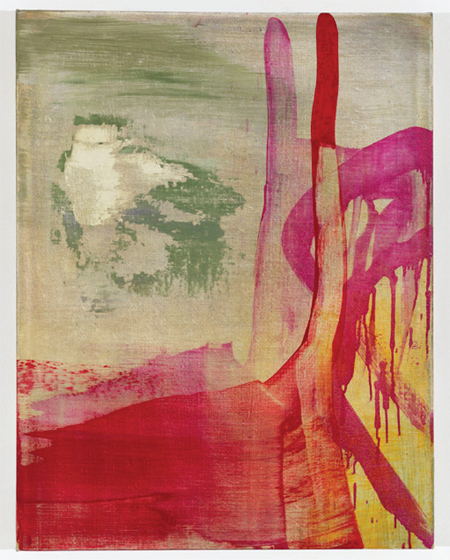
The recent work of Peter Mohall takes the starting point from two paintings he made in 2007, “Studio View no.1 and no.2”. When allocated a temporary, unpainted studio at the Academy, there were bare walls built with composite wood plates  – Oriented Strand Board.

Mohall was fascinated by the turmoil in the structure of these walls. Close-up photographs of the small details were transferred and enlarged on the canvas, with a Gerhard Richter-blurred photorealism. The image was limited to shades of green, to give the impression of a forest landscape. The intention was to create a virtual loop in a visual manner, taking the painting back to the source of its motif – the forest.

.

Mohall further extended this project to another series of paintings with the title “Faux Bois”, a reference to the traditional craft of imitating wood-grain. Instead of the norm of imitation of expensive hard woods, he utilised one of the cheapest kind – OSB. The motif is similar to the previous series, though the approach is changed to a more broad use of different painting applications and multiple colours.

In “Faux Bois” the image-composition is investigated through chaos theory. An intuitive system of colour-fields is arranged throughout the canvas to shape the landscape that appears from the almost absolute chaos of the structure within the OSB. A similar phenomenon to cloud spotting, where imaginary figures appear in the sky to the viewer.

“Studio View” and “Faux Bois” are pure studio-based works, where the act of painting is performed, and the motif is excavated within the studio. This working manner resembles the approach of Piet Mondrian with his wall-works, where he also merged the studio into the process of painting, making the project an enclosed environment.

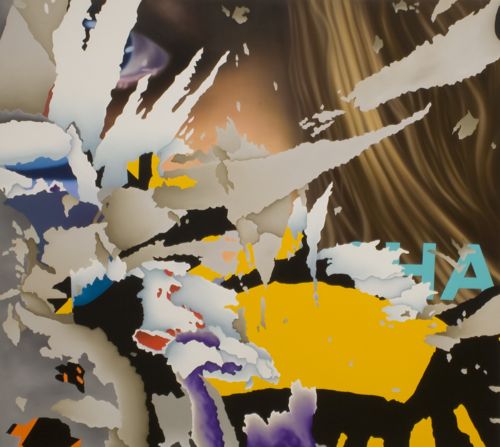
The last year, Mohall has done the opposite and ventured outside in the sourcing of motifs. He has been  working with a new project called “Fractal Figuration”. The paintings maintain the fractal imagery that characterizes his former work and place it in a new context. He uses the aesthetics familiar to Jacques Mahé de la Villeglé of the Nouveau Réalisme, using photographs of decayed posters as model, a sort of ready-made décollage

Though all three series are painted after photographic drafts, “Studioview” and “Faux Bois” are perceived as non-objective paintings, this time he turns towards the margins of the figurative. “I’m interested in the deconstruction of the motif’s ability to relate to abstract imagery. While ”Fractal Figuration” obviously is representative, it still has elements resembling abstract works of, for example, Kandinsky and Schwitters.”

The work of Peter Mohall is based on deconstructed motifs. With loose collections of related fragments, the paintings have the characteristics of the architecture conceptualized by Jacques Derrida, Deconstructivism,
A Gallery

Håkan Rehnberg
//Counter-moment

braskart
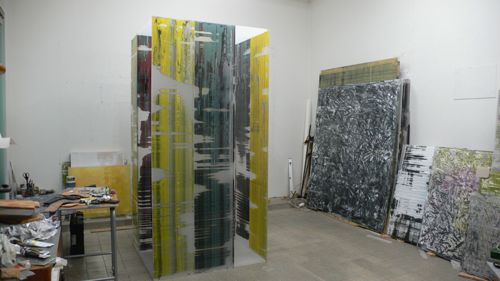
For the last 30 years Håkan Rehnberg has methodically explored space and flatness in his painting. His choice of plexi-glass is an acknowledgement of the physical properties of the object on which he paints: plexi is a screen, an object and a frontal plane. For Rehnberg the decisive moment of painting, full of contradictory impulses, intuition and intention, is one of exposure and vulnerability.

With broad strokes, defined by a plasterer’s palate, Rehnberg draws out planes of colour, carving out spaces. In a process of layers he both reveals and conceals, leading to what can be seen as a flattened architecture – an inaccessible room.

The inaccessible room is both a physical place and a conceptual site. In his sculptures the room becomes almost inhabitable, sometimes inviting shelter and yet providing none. Often a closed space with only visual access, the sculpture recalls an eddy in a river – a recurring thought.

In this exhibition Rehnberg continues to explore these themes in new directions. Two works suggest a forensic archaeology – a scraping away to the white “bone” under the surface. Another painting reveals a frenetic scratching in a swarm of gestures.

The form of a beehive occurs repeatedly in the new works and combines the concept of the inaccessible room with the elements of revealing and concealing. The yellow, scented, beeswax is both painterly and sculptural.

Håkan Rehnberg will represent Sweden at the Sydney Biennale in May this year. He recently received great attention for his contribution to Åtta Kommentar in the Caspar David Friedrich exhibition at National Museet. He has exhibited widely both in Sweden and internationally, including Charlottenborg Kunsthal, Copenhagen, Studio A, Otterndorf, Museum gegenstandsfreier Kunst (Germany), Sønderjyllands Kunstmuseum, (Denmark), Reykavik Art Museum (Iceland), Helsinki City Art Museum (Finland), Centre Culturel Suédois (France). Venues in Sweden include Moderna Museet, Malmö Konstmuseum, Millesgården, Eskilstuna Konsthall, Rooseum, Wanås slottspark, and Liljevalchs Konsthall. Håkan Rehnberg was born 1953 in Göteborg. He lives and works in Stockholm. This is his fifth exhibition at Galerie Nordenhake.

Galerie Nordenhake

Marius Engh

braskart

The first work of Marius Engh I ever saw had me pretty much seeing nothing. Entering the installation of his graduation exhibition almost ten years ago I was offered nothing more than a pitch dark space. Hesitantly inching my way forward, I realized soon after having turned several corners that the space had also had turned into a labyrinth. I was confronted with a profound doubt regarding the point and purpose of the piece, but more importantly I was doubting my ability to return to the entrance. The solution was somewhere in between: I stood still and hoped for my eyes to adjust to the darkness. Marius Engh’s works have since always required and rewarded in the same manners: wait and there is a chance you’ll be able to see.

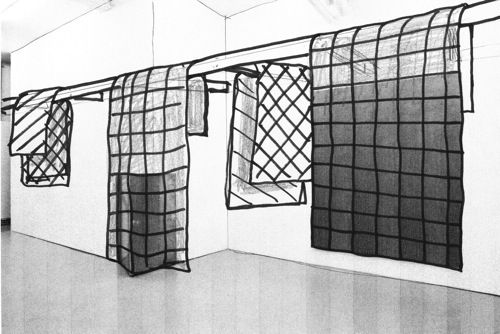
“Time has turned into space, and there will be no more time till I get out of here” – Engh’s choice of title does not only serve as a reminder of the disorientation experienced upon initially encountering his works, but also serves as a reminder of the inherent theatrical qualities to his sculptures and installations. For his third solo exhibition at STANDARD (OSLO) Engh leaves the gallery with a single work; a beam structure running the entire length of the exhibition space from which four quilts in have been suspended. A clear, clean, but yet eerie and empty arrangement. Engh’s work has the incompleteness of a prop or a backdrop, still awaiting its activation by the presence of somebody or something else. Taking its title from Samuel Beckett’s Texts for Nothing (1-13) (1950-52), the installation reveals an interest in a similar form of standstill. Or at least – knowing that a complete condensation of verbal and pictorial information is not permissible – a slowing down of coming into knowing. As is the case with so much of Engh’s work it possesses an annoying quality: an insistence on seemingly insignificant signs that in the absence of alternatives not only have to be trusted as the sole source of information but also trusted to be of some importance.

The pessimism of Michael Fried every so often proves itself purposeful; still waiting for that convenient glimpse of light to interrupt the solid opacity of Engh’s installation, I was reminded that indeed my fumbling around could be what there was. Fried’s seminal essay “Art and Objecthood” (1967) launched an attack on the then contemporary practice of minimalist art and what Fried saw as a location of content in the viewing situation rather than with the work itself –  making the viewer’s response (the search for the pictorial content that has been omitted) the matter of concern. Why then even turn on the light? Touché, Monsieur Fried, but then again the question remains (with the fear of sounding zen kitsch): what constitutes absence and what constitutes presence? Rephrasing the question: how have the threshold values of information or notions of iconography (or its absence) been subject to continuous negotiation since Malevich’s monochrome and the void turned pictorial, Yves Klein’s leap into the void, Robert Smithson’s “Museum of the Void” or John Cage’s “4’33″” and the claim that “there is no silence that is not pregnant with sound”?

What Engh offers may, however, not so much be silence as a devaluation or re-evaluation of sign value. The four quilts here on display seem as much motivated by decorative as by communicative ambitions, leaving it unclear whether they are to be stood as mere ornaments or having any significance as signs. Hanging from the naked wooden structure, the four quilts resemble the flags of an optical telegraph where the bold patterns and rich array of colours would serve as syllables. However, the intense sensation of a language unfolding does not prevent the simultaneous sensation of meaning folding in. Recognizing being underprivileged yet again, I merely wait for the muteness to perforate.

Standard Oslo

Tofer Chin

Alex_invite2

A highly-regarded explorer of visual communication, Aldous Huxley once said, “The man who comes back through the Door in the Wall will never quite be the same as the man who went out.” The same can be said about a few particular months of teenage life experienced by artist Tofer Chin, depicted, from memory, in his new body of work, showing at the Fecal Face Gallery in San Francisco.

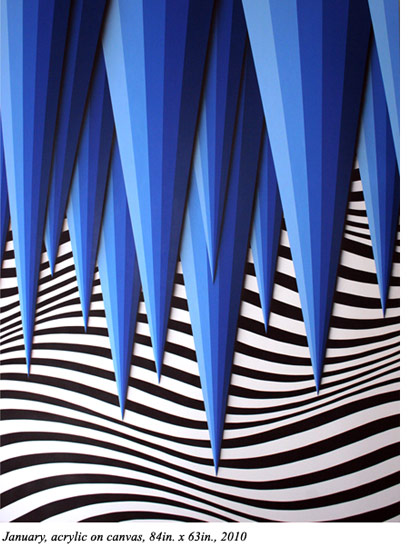
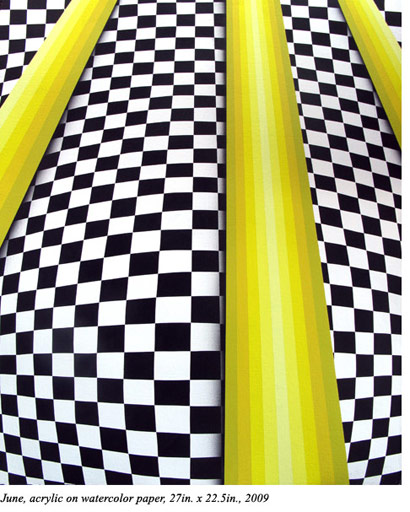
Entitled “Alex,” Chin’s new show further represents his on-going relationship with Op-Art, as well as his perseveration on sensory perception and mind expansion, while also impressively marking his move to wholly personalize and reinvigorate the movement. Whereas previous works used unnatural color and concept to examine the spiritual and psychological impact of synthetic LSD, “Alex” strives to enhance the personal and shift to the organic by refocusing on the naturally-derived hallucinogen, mescaline. Unlike LSD, mescaline never lies. Instead, the mescaline experience includes visual enhancements of originating truths.

Identical to the intricate components frozen in each of Chin’s new works, these fleeting enhancements come in the form of recurring visual patterns such as stripes, checkerboards, angular spikes and other very simple fractals which can and ultimately do turn very complex. This, en total, surmises the intended shape of Chin’s current exploration.

“Alex,” Chin’s most personal showing to date, represents a finite period, a series of particular months, connected by a hard line of earth tones, deliberately involved, only to be exhilerated through the mescaline eyes upon which they reflect. Catch a glimpse from the confines of your controlled mind as trip excerpts pause on the gallery walls. Bare witness, assuredly safe, as Chin completed the actual experience evoked, long, long ago.

Chin’s showing at the Fecal Face Gallery also marks the release of his new limited-edition acid print. Entitled “No. 1.2.” This signed and numbered print will be available through the gallery.
About Tofer Chin
Tofer Chin, a Los Angeles native, continues to exhibit, in both gallery and museum, in Los Angeles, New York, San Francisco, Barcelona, Sao Paulo and Australia. Past works appear in The Los Angeles Times, Flaunt, Nylon, Theme, Trace, Big, Vice and Rojo. In 2006, Rojo published his first book of photography, entitled ‘Finger Bang’, and in 2008, published his highly anticipated follow-up, entitled ‘Vacation Standards’. In 2009, Chin participated in ROJO – OUT Urban Stage Sao Paulo where he was selected to create a permanent site specific painting on three massive concrete structures in the center of Sao Paulo, Brazil.

Fecal Face

BILL JENSEN

Bill-Jensen
Cheim & Read is pleased to announce an exhibition of paintings and works on paper by Bill Jensen. The show is accompanied by a full-color catalogue with an essay by David Hinton, a prominent scholar and respected translator of Chinese poetry. This is Jensen’s second show with the gallery; his first was in 2007.

Bill Jensen was born in Minneapolis, Minnesota in 1945 and received his MFA at the University of Minnesota in 1970. He has lived and worked in New York since the early 1970s, maintaining a studio in Williamsburg, Brooklyn. Jensen has long been respected for his unconventional abstractions, their compositions evocative of otherworldly landscapes where spatial definition is informed by structural logic. Shape, line, and intense color follow unpredictable paths, but coexist in psychic harmony. Influence of the early American modernists (Albert Pinkham Ryder, Arthur Dove) and the Abstract Expressionists (Jackson Pollock, Mark Rothko, the prophetic Arshile Gorky) are evident, as are the visionary canvases of Myron Stout, and Forrest Bess.

Jensen is also inspired by Taoist philosophy, Chinese painting, and ancient and contemporary Chinese poetry. The third and fourth century Taoists believed that pure nature could not be experienced by humans, due to their inevitable mannerization of the natural world. Chinese painters subsequently attempted to depict the phenomena of nature “itself.”  This history, linked to the idea that all matter is the same-the understanding that something is everything and everything is something-was of profound influence on Jensen. An intuitive, unpretentious painter, Jensen strives to attain content originating in the psychic and emotional; for him, content is more important than result. Jensen argues that his paintings’ beauty, or lack thereof, is not his decision, but determined by the painting itself.

Devoted to his craft, Jensen makes his own paints with finely ground pigments and a self-developed oil-based medium. This allows him to control viscosity and saturation, and provides a wide spectrum of color and texture in his paintings. His methodology consists of multiple layering, scraping, seeping and “dredging,” and is determined in part by unusual, self-made tools. Jensen’s experimental painting techniques are pivotal to the outcome of his heavily worked canvases. As he has stated, “Solutions come from the working process.”

The recent paintings on view in this exhibition show the range of Jensen’s process and the depth of his content, from ethereal, washy forms, to dense, physically worked surfaces of color and texture, punctuated by titles like Genesis, Time After Time and Occurrence Appearing of Itself. Saturated red, blues and yellows coalesce, extending in and out of space, retreating and aggressively reappearing. The drawings and works on paper, some black and white, are more intimate in scale, but still contain the translucency and intensity of the paintings. The black and white works, with their variety of tones, read as if they were in color, while the color drawings radiate hypnotic clarity. Drawing has been a constant throughout Jensen’s practice, and was at times his main mode of artistic exploration. Its direct relationship to his painting is evident.

The sense of freedom in Jensen’s work is belied by the commitment, consistency and seriousness with which he approaches it. As he says, “Each work for me is not about one idea; it is about an emotional event that must be searched for and clarified.”  Jensen achieves his goal of transforming the viewer’s experience, providing a peek into the transcendent.

Cheim & Read