Jack Pierson

Billede 1

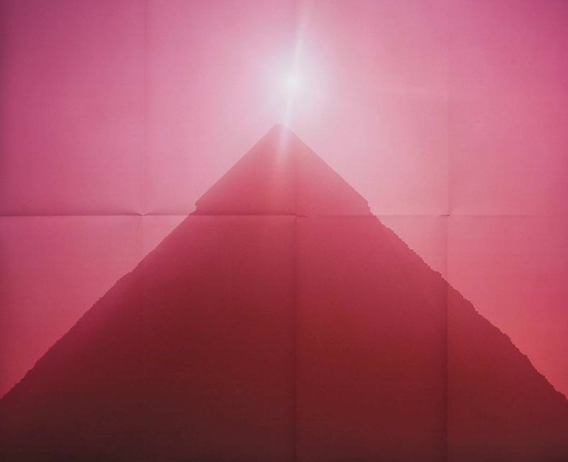
Bortolami is proud to present Go there now and take this with you, a show of Jack Pierson’s folded photographs.

While Pierson is best known for his wall sculptures, he has been working as a photographer since he was in art school in the 1980’s. He later expanded his practice to both sculpture and word pieces. The themes of his art are investigated through all mediums, but perhaps they are most directly addressed in his photography due to the concrete representation afforded by the imagery. Pierson’s choices of subject matter seem sprawling, but they are linked by beauty and a thread of passing drama, sexual tension, and ephemeral glamour.

Pierson has always struggled with the needs of photography as a medium.  Framing, mounting and glass, separate the observer from the work itself, making the photograph a cumbersome object.  The photos presented in this show challenge the need for protection and hang directly on the wall, exposed to the viewer much like the word pieces. Each work is printed on photo paper and folded suggesting that the works are portable. One can take the picture with them in an envelope, or send it to a friend, for hanging and re-hanging in new settings.  The picture is intended to age and evolve rather than remain a static print behind glass and a frame.

Jack Pierson was born in Plymouth, Massachusetts in 1960 and attended the Massachusetts College of Art in Boston. He lives and works in New York and Southern California. Pierson has had solo exhibitions at El Centro de Arte Contemporaneo de Malaga, Spain; The Irish Museum of Art, Dublin, Ireland; The Museum of Contemporary Art, Miami, Florida and the Museum of Contemporary Art, Chicago, Illinois.
Bortolami

David Berezin: Combo

Billede 1

The Jancar Jones Gallery is pleased to announce an exhibit of the work of San
Francisco-based artist David Berezin titled Combo. Through an exploration of
stock images and cultural practices, Berezin combines signs to ultimately
critique the ways in which “pop meaning” can be understood.

In a previous series of photographs, he recreates canonical still lifes from
art history, built with images from the Internet and stock photography. Where
the vanitas still lifes of the 17th century that he references were
symbolically rich, his still lifes do not carry the same specific meaning.
Instead, his interest in the work comes from its construction: historical
images with precise meanings are recreated with collaged low-resolution
images that are free and available through a Google image search. As a
result, the original meaning of the composition is disrupted, through the
interpretation of the contemporary replacement imagery.

In a new series of still lifes, which will be included in Combo, Berezin
removes the historical referent, instead focusing on narrative content. Using
a precise combination of contemporary signifiers, he builds an image which
could evoke the residue of a theatrical plot. Given movie-like titles, he
emphasizes the predictable nature of Hollywood narrativity and how embedded
it has become in American vernacular, while simultaneously confusing this
read through the deliberate use of incongruous yet stereotypical symbols.

Using a similar gesture, Berezin will also construct an installation of
bedroom posters and ephemera. In the same way the arranged items in the still
lifes connote a narrative, the bedroom posters function as a highly legible
building block to a peculiar personal identity; allowing for an extremely
fast read, there is no confusion as to what a FREE TIBET poster means in a
bedroom. In spite of the often easy read, Berezin obscures the signifiers
with which he works, again drawing attention to the language of popular
culture that often is taken for granted or over looked due its over
saturation or over use.

David Berezin received his BFA from the California College of the Arts, San
Francisco.

The exhibit will coincide with a small edition release of “You know, we have
a lot of friends, but there’s something about Mary”, a collaborative book
project by David Berezin and Harsh Patel.


The Jancar Jones Gallery

Tucker Nichols

braskazieher

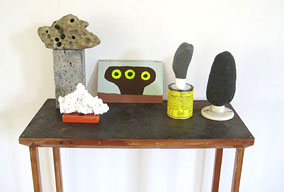
In his third solo exhibition at ZieherSmith, San Francisco based-artist Tucker Nichols presents sculpture, panels and works on paper created during a recent residency at the Headlands Center for the Arts in Sausalito, California. Recent projects include Temporary Storage Overflow Plan #3 in collaboration with Baer Ridgway in 2010 and interventions at the de Young Museum when he was artist in residence in 2008. His work will be included in the forthcoming California Biennial at the Orange County Museum of Art. ARTNews selected Nichols as an “artist to watch” in February 2010. Below is an excerpt from an interview with curator Dakin Hart; the entire text is reproduced in an artist’s book available in a limited edition at the gallery.

The work in your new show seems to suggest a kind of bricolage metropolis. You’ve lived in New York and other cities, but now you keep chickens, frequently abandon your studio to a flooding creek and spend lots of time walking in the hills. Is the grass always greener for artists, too?
I love New York, but as soon as I got to California I felt like I could breathe again. Breathing and making things go well together for me. That said I think about NYC often, and for this show I made a lot of the work from the perspective of someone who had heard a lot about New York, maybe from his uncle or from a pamphlet from the World’s Fair, but had never been. He assumed that people in New York would relate better to things that looked like where they live, so he kept trying to capture the city from what he had heard. You can try, but you’re a fool if you think you can really capture something so big and dynamic. Art is so much smaller than New York City.

You’ve been assembling objects—many poignant like the things we collected and kept as kids—for a long time, but you’ve only fairly recently started showing them. Is it hard to let those go, even when you feel like you’ve made a good piece?
The successful sculptures are hard to let go—it’s partly how I know they’re ready. I really didn’t want to be a sculptor. It seemed like such a pain to deal with all the things you end up making, adding more stuff to the world. Drawings pack away so neatly. But I can’t help myself; if I’m interested in our relationship to things, I have to work with things. A lot of the work in this show I made from things I’d like to keep but am secretly hoping I won’t have to ever see again. I’m conflicted about loving things and wishing they’d all go away, and making sculpture is somehow a good way for me to think about all that. Without that it’s just getting rid of stuff and as you know that’s just a relief.

At ZieherSmith you are showing works you made in a sun-dappled studio with window sills, bumbling bees, peeling paint, absolute silence and green stuff outside. In New York, are they going to be fish out of water; frogs crossing a road between culverts; or happy as clams?
Well as of this interview I’m not there yet to see it. But this work was made and chosen to be shown in New York, so it’s where it’s all supposed to go. I’m as curious as anyone how it will translate, but if it looks wrong that might be even better. You can’t make things in one place and have them look just right someplace else. It doesn’t make any sense. I like my things to feel a bit out of place, a bit lost in the shuffle. This show is like a giant postcard to the city. It looked good from this end.

ZieherSmith

Chris Beas.

braskart


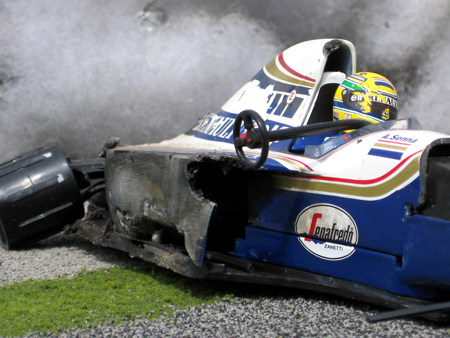
Chris Beas will present new paintings, drawings and sculpture based on the greatest Formula One driver to ever put pedal to metal and the events of May 1st 1994 when Ayrton Senna crashed and died during the San Marino Grand Prix while going nearly 200 mph around Tamburello corner at Imola.

For this exhibition, Beas has created ten new paintings consisting of die cast metal replicas of each car Senna drove during the first ten years of his F1 career from 1984 -1993. The paintings work both collectively, serving as the biographical framework of Senna’s F1 career, and individually, exploring the affect a car driven at such high speeds has on its surroundings. Beas has also created two sculptures. A 1/32-scale replica slot car track of the F1 circuit at Imola measuring 250 x 103 inches encompassing nearly 50 ft. of track will serve as the site of the San Marino Slot Car Grand Prix. The second sculpture recreates Senna’s impact into the wall at Tamburello corner and its aftereffects.

Chris Beas was born in Sierra Madre, CA and he lives and works in Los Angeles. He previously exhibited at the Prague Biennale 3, Prague, Czech Rep.; Parc Saint Leger Centre D’Art Contemporain, Pougues-les-Eaux, France; The Beautiful Game: Art and Fútbol, curated by Franklin Sirmans and Trevor Schoonmaker, New York, NY; Casey Kaplan, New York, NY.

Martha Otero