Tag: Taka Ishii Gallery
Sterling Ruby // “New Works”
Ken Kagami //
![3[3]](http://www.braskart.com/wp-content/uploads/2010/08/331.jpg "3[3]")
![5[2]](http://www.braskart.com/wp-content/uploads/2010/08/521.jpg "5[2]")
Ken Kagami
![1[4]](http://www.braskart.com/wp-content/uploads/2010/08/14.jpg "1[4]")
![4[1]](http://www.braskart.com/wp-content/uploads/2010/08/411.jpg "4[1]")
Ken Kagami //
![1[5]](http://www.braskart.com/wp-content/uploads/2010/08/15.jpg "1[5]")
![5[1]](http://www.braskart.com/wp-content/uploads/2010/08/51.jpg "5[1]")
Ken Kagami
![1[3]](http://www.braskart.com/wp-content/uploads/2010/08/13.jpg "1[3]")
![2[2]](http://www.braskart.com/wp-content/uploads/2010/08/22.jpg "2[2]")
![3[2]](http://www.braskart.com/wp-content/uploads/2010/08/321.jpg "3[2]")
Ken Kagami //
![1[2]](http://www.braskart.com/wp-content/uploads/2010/08/12.jpg "1[2]")
![2[1]](http://www.braskart.com/wp-content/uploads/2010/08/21.jpg "2[1]")
![3[1]](http://www.braskart.com/wp-content/uploads/2010/08/311.jpg "3[1]")
Ken Kagami /

Naoko Tamura & J. Parker Valentine
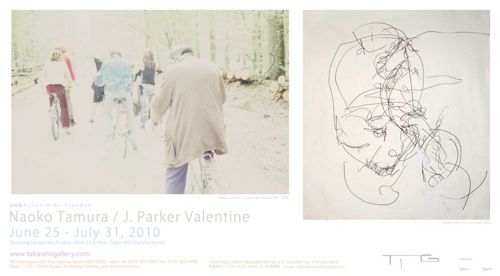
Taka Ishii Gallery is pleased to announce concurrent debut exhibitions in our Kyoto space: Tokushima-born-and-Kyoto-based artist Naoko Tamura and Texas-born-New-York-based artist J. Parker Valentine. Naoko Tamura previously exhibited at both Taka Ishii Gallery (Tokyo, 2004) and gallery.sora. (Tokyo, 2006). In 2009, in collaboration with filmmaker Shinji Aoyama, Tamura presented an installation at VACANT, Tokyo. In addition to gallery exhibitions at Lisa Cooley (New York, 2008/10), and a scheduled exhibition (2010) with Supportico Lopez, Berlin, Valentine’s work has been presented at the Contemporary Art Museum St. Louis (2009).
Naoko Tamura works primarily in the media of photography – though she has tentatively experimented, as well, in the media of film, installation and performance. At first glance, it would appear that her photographic work may be divided into two categories – the atmospheric and cerebrally abstract; atmosphere embodied in the 2004 Seigensha publication Voice and the cerebral in the untitled series of photographs published, serially since 2009, in the psychology journal Psychiatric Mental Health Nursing. Tamura’s commitment to the generally abstract nature of photographic representation results in a literal blur between these apparent categories and to a body of work which, though resistant to unification, is painstakingly consistent. Thus a luridly vibrant blush of blur – in truth an arrangement of flowers photographed at a range beyond close – is no less concrete and, conversely, no less alien than the grounds of an otherwise anonymous space, in fact the psychiatric hospital, Clinique de La Borde. Tamura’s new publication is anticipated for release in Autumn, 2010.
J. Parker Valentine is a post-conceptual draftsperson. While crafting artwork in a variety of media, Parker’s practice amounts to an elemental yet informed engagement with the act of mark-making. Endowed with a literal weight, in part a consequence of her often chosen carrier – MDF panel – and, contrastingly, informed by the act of erasure, Parker’s works embody site specificity; their internal drama, without resorting to the expressive, is nonetheless remarkably representative of a space in which something – the act of drawing – happens. Hyper-specific, the work presents a stubbornly finite presence, decidedly foreign in relation to common contemporary practice dependent, for any trace of the sensual, upon recourse to an implied infinite regress. Work on view in the Kyoto exhibition will be completed during a one month residency on Parker’s first visit to Japan.
Nobuya Hoki
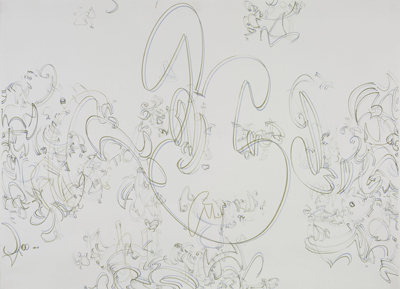
Taka Ishii Gallery is pleased to announce our exhibition with Nobuya Hoki. Born in 1966, a graduate from the Kyoto City University of Arts (MFA, painting), Hoki lives and works in Kyoto. He has been included in numerous international exhibitions including Roppongi Crossing: New Visions in Contemporary Japanese Art 2004, Mori Art Museum, Tokyo, and GARDEN OF PAINTING: Japanese Art of the 00s, The National Museum of Art, Osaka (2010). In April of this year, he is scheduled to exhibit at the Suntory Museum in Osaka as part of the exhibition, Resonance.
At first glance, Hoki Nobuya’s paintings appear to consist of little more than nondescript linear expressions. But even after a short gaze at his work, every viewer will realize that most of his lines are actually made up of two parallel lines. Hoki refers to this means of expression as “nihon-ga” (lit., “double painting”). …This was part of an audacious, yet (or so Hoki believed) still unrealized, attempt in the history of painting to completely eliminate the symbolic meaning inherent in an image while still depicting it. …Considering the remarkable results that Hoki’s bold approach has produced, his “nihon-ga” have led to the realization of a truly Japanese form of painting or Nihon-ga.
This is Hoki’s second solo exhibition following his 2008 show at the newly opened, Taka Ishii Gallery Kyoto space. In this forthcoming exhibition, he will be presenting oil-painted works on panels, alongside two series of drawings; a portrait which attempts to perceive a new “surface” for the human face, and what the artist himself refers to as “Ji-matagi” (lit., “Material (Color) Strides”), a “Nihon-ga” piece in which he constructs two lines –one more and one less luminous in contrast to the original color of the Material (paper).
By dividing one color into two complementary colors (for example, Black into Red and Blue) and allowing those lines to travel side by side in a subtle trajectory, Hoki creates a radical three-dimensional portrayal of depth, “a multi-stratifying of single layers” and seeks a new potential for painting which is free from a traditional approach.