Tag: New York
/ (LEAN)
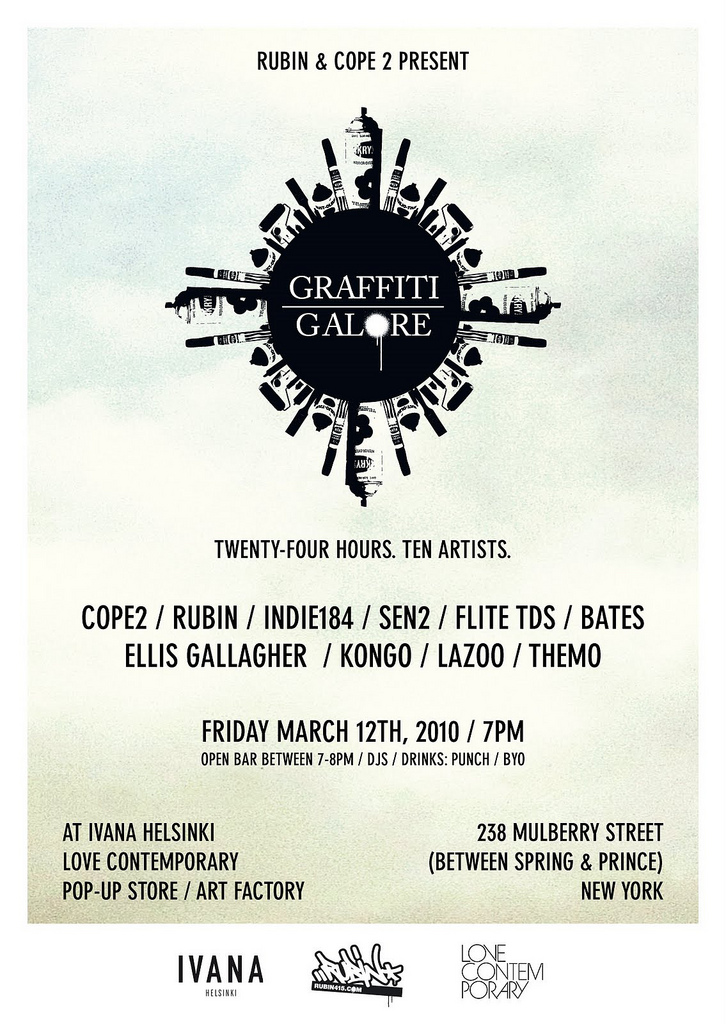
Graffiti Galore
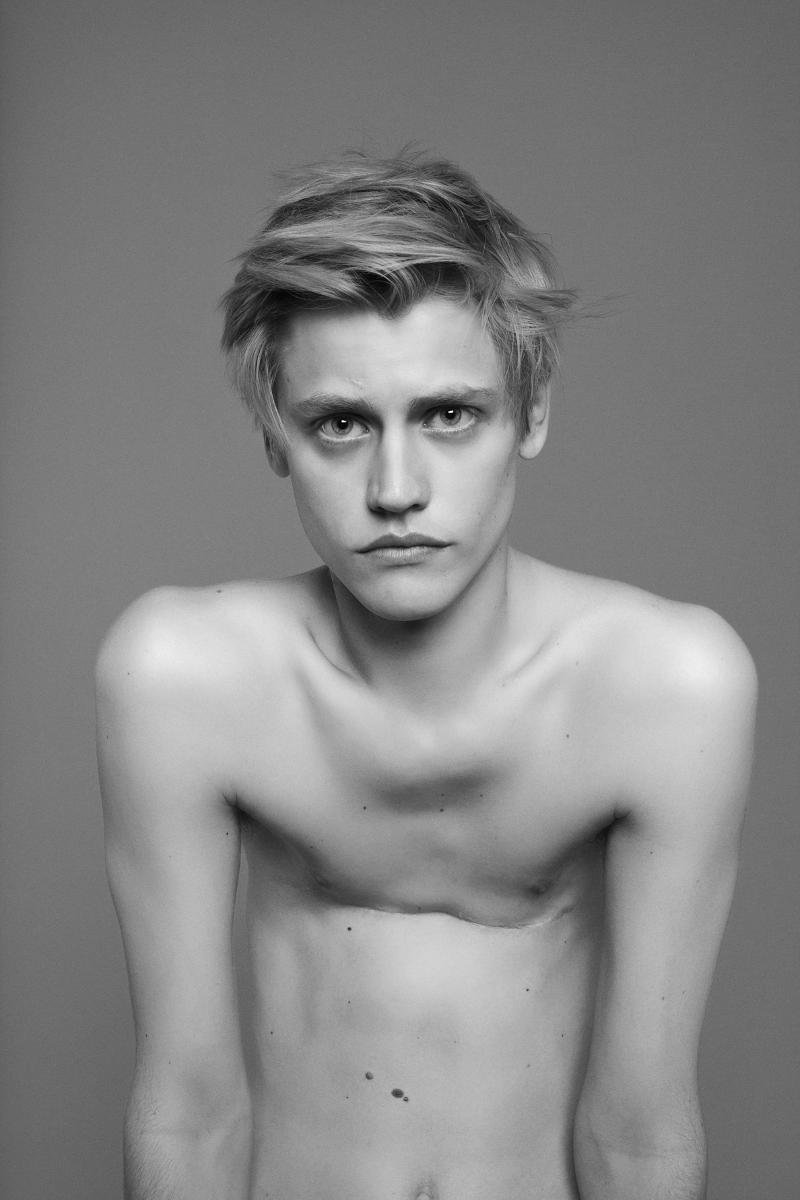
Ryan McGinley @ Team Gallery
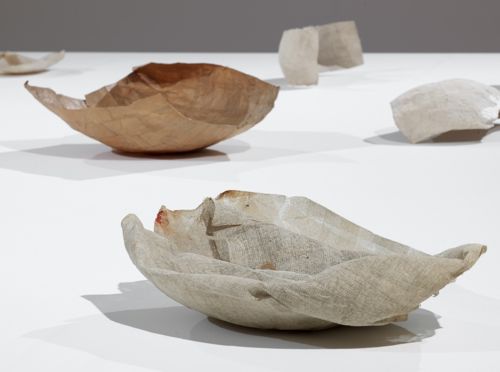
Eva Hesse @ Hauser & Wirth
Donald Judd
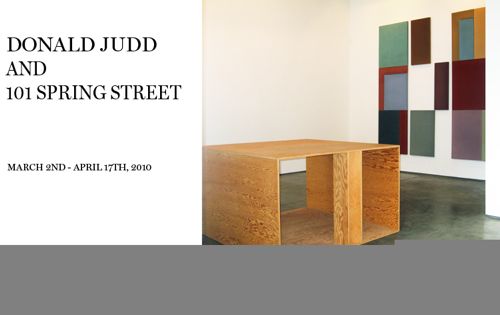
In 1968, Donald Judd purchased 101 Spring Street, a 5-storey cast iron building, which today remains the only single-use cast iron building in SoHo. The premises was a home for Judd and his young family, provided a studio for him to work in, and also provided a forum for him to begin his process of installing his work and the work of others in a permanent fashion.
In the Summer of 2010 the house will close for 3 years for a major restoration, and in commemoration of this Nicholas Robinson Gallery and Maurice Tuchman will curate an exhibition of artworks by those artists whose works formed the permanent installation at the time of the artist’s death in 1994. Including examples by Hans Arp, Larry Bell, John Chamberlain, Marcel Duchamp, Dan Flavin, Donald Judd, David Novros, Claes Oldenburg, Ad Reinhardt, Lucas Samaras, Kurt Schwitters and Frank Stella, and archival material from the Judd Foundation the exhibition seeks to celebrate the house as both a home and a vital meeting place and conduit in the lives and works of these seminal artists.
Judd’s concept of “permanent installation” centered on the belief that the placement of a work of art was as critical to its understanding as the work itself. His first applications of this idea were realized in his installation of works throughout 101 Spring Street. His placement of artworks, furniture, museum-quality decorative objects, and the accoutrements of domesticity in this historic building illustrate specific and careful choices, highlighting the attributes of the fine structure and innovating a mode of living that is still considered today to be the archetype of loft habitation.
Through his succinct writings Judd precisely elucidated his ideas about his own work and what he considered the principal responsibilities and function of the art object. From 1959 to 1965 he was also a prolific critic, hired by Hilton Kramer to write reviews for Arts (and from January 1962, called Arts Magazine), in which he applied his rationalist thinking to the works of others, the manner in which they were displayed, and what he considered to be both the relevant and redundant aspects of modernist artistic practice, thoughts which presumably informed his own collecting tastes.
In his essay ‘101 Spring Street’ Judd had the following to say about the building:
Sofi Zezmer
JOSÉ Mª YTURRALDE
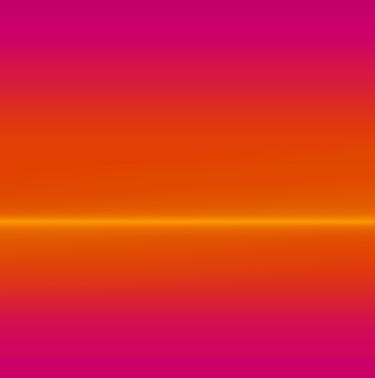
GERING & LóPEZ GALLERY is pleased to present JOSÉ Mª YTURRALDE: Horizons. This is the Spanish artist’s second exhibition with the gallery in New York.
This exhibition consists of Yturralde’s newest series, which further delves into his exploration of the phenomenology of perception through the discipline of painting. Long concerned with Gestalt theory and the figure/ground relationship, Yturralde introduces distinct lines into his color fields, not unlike the zips of Barnett Newman. These “horizon” lines differ from Newman in that Yturralde has spun them on different axes, altering our spatial understanding of his pictorial expanse. The boundaries of the picture plane are thus grounded around clear and intentional horizon lines, orienting the viewer in Yturralde’s often all-consuming voids of beautiful color.
These canvases serve as metarational meditations on a wide range of intellectual and spiritual interests of the artist. Yturralde’s work involves an interplay between the immanent and the transcendent; the works appear in front of the viewer as contained canvases and yet they transcend the constraints of the medium to evoke a metaphysical experience of limitless space and light. The Horizon works demonstrate a new phase in Yturralde’s study of chromatology, as the more severely striated color fields seem to emit an energy associated with the hues’ spectral locations. Constructed with the help of mathematics and physics, these paintings produce an organic sensation that touches on the sacred, as Yturralde melds science and religion to create powerful works that stretch the viewer’s understanding of their own perceptual expectations.
Born in 1942 in Cuenca, Spain, José Mª Yturralde currently lives and works in Valencia. Yturralde has been included in many important exhibitions around the world such as the Sao Paulo Biennial (1963) and the Venice Biennial (1978). Other significant exhibitions include a retrospective at IVAM of Valencia in 1999 and group exhibitions at the Museo Nacional Reina Sofía, Madrid; Museum of Modern Art, México; The Museum of Modern Art, Toyama, Japan; Museo de Arte Contemporáneo de Madrid, Spain; Massachusetts Institute of Technology, Cambridge, Massachusetts; and Museo Nacional de Bellas Artes, Buenos Aires, Argentina. His work is found in several important international collections including the Brooklyn Museum of Art, New York; Hastings Foundation, New York; Museo de Arte Contemporáneo, Vitória, Brazil; National Museum in Wroclaw, Poland; The Asahi Shimbun, Tokyo, Japan; and the State Museum of Novgorod, Russia.
Gering & Lopez Gallery
Michael Gregory
Camille Rose Garcia
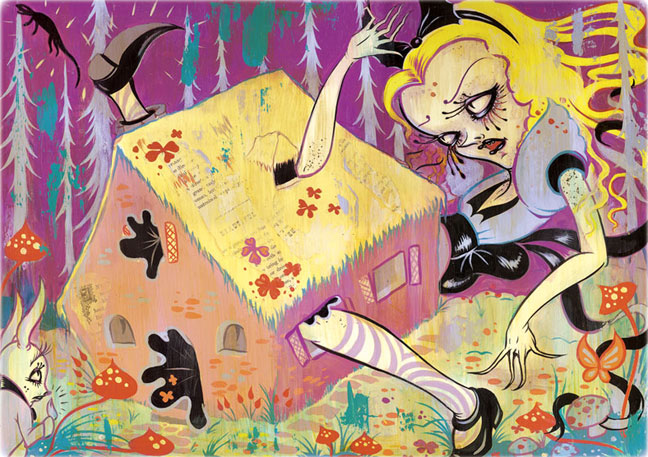
Merry Karnowsky Gallery is proud to present “Down The Rabbit Hole,” an
exhibition of new work by Camille Rose Garcia. The opening reception on
March 6th will celebrate the release of Harper Collins’ new edition of Alice’s
Adventures in Wonderland, illustrated by Camille Rose Garcia, as well as new
paintings inspired by the book.
In the original illustrations that will be on display, Garcia brings one of
literature’s most beloved characters to life in her trademark dark yet whimsical
style. Pairing watercolors with her usual bold acrylics, Garcia captures Lewis
Carroll’s dream-like fantasy world in a fresh and exciting visual reinterpretation
of the classic story.
The Disney-gone-wrong style that has earned Garcia international acclaim is
a natural fit for Carroll’s fantastical story. The vibrancy of her illustrations draws the viewer in and breathes
new life into the familiar narrative. For “Down The Rabbit Hole,” Garcia continues to explore Wonderland in
a distinctive exhibition of new artwork that picks up where the book leaves off.
Garcia grew up in the shadow of Disneyland in Orange County, and she received a Master of Fine Arts
degree from The University of California, Davis. A mid-career survey of her work was shown at the San Jose
Museum of Art in 2007. Three other books of her work have been published, The Saddest Place on Earth,
2005, The Magic Bottle, 2006, and Tragic Kingdom, 2007.
Garcia’s work has been featured in Flaunt Magazine, Nylon, Paper Magazine, Modern Painters, Art
Prostitute, Juxtapoz, Hi-Fructose, LA Weekly and The Los Angeles Times. Her art has been exhibited in Spain,
Germany, France, and Italy, as well as numerous cities in the United States. She currently lives with her
husband in Northern California.
Garcia will be signing books at the party on March 6th, which will feature special musical guests, cupcakes,
and beverages provided by Bear Flag Wines and Honest Tea. Books and new limited edition giclées will be
available for purchase.