Søren Martinsen

braskartblog

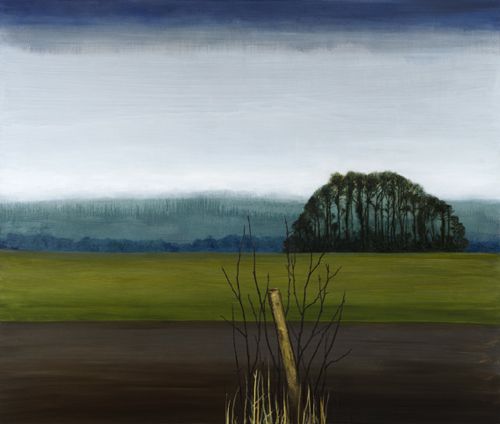
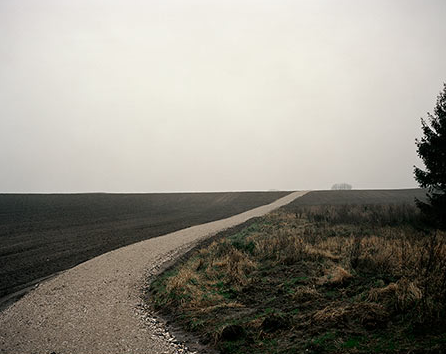
The Utopian notion of the Good Life in the countryside is challenged, even shattered in Søren Martinsen’s interior and landscape paintings, which can be seen at the Martin Asbæk Gallery until 16th October 2010. As a new feature the works in the large format have been painted on raw linen with a mixture of thin layers of acrylic paint and subsequent thicker layers in oils.

The exhibition title Field Studies refers to the artist’s scientific approach to and in-depth investigation of the man-made domestic landscapes and the natural, classic Danish landscapes that the artist frequents on a daily basis around Glumsø. The panoramic landscape depictions have been recreated with the aid of photographic registrations and clear memories. But the direct references in the works to actual places and the succession of the seasons entails an anything but naturalistic look – rather a timeless and unreal impression. The works take on the character of psychedelic landscape paintings which at one and the same time affect, transform and enrich the viewer’s perception of the reality of normally idyllic landscape subjects. Even the titles of the works, such as Fluoxetine 60 mg, distort one’s ideas of the romantic life in the countryside and emphasize the psychedelic idiom of the works.

The works present a glimpse of an external reality that is cropped and manipulated by the artist. The process of creation is thus ascribed to an almost symbolic mechanism which entails that the landscape subjects, with their differences in both composition and choice of colours, can be read as a portrait of the artist Søren Martinsen or as a product of the artist’s mind.

Søren Martinsen (b. 1966) studied at the Royal Danish Academy of Fine Arts in 1995 and has a master’s degree in Fine Art from Goldsmiths, University of London from 1994. Martinsen is also currently exhibiting at Overgaden Institute of Contemporary Art with Children of the New Age, where the viewer is taken, in the documentary video work of the same name, on a journey into a religious universe far from our rational everyday life.
Martin Asbæk

Lisa Strömbeck – Martin Asbæk

braskartblog

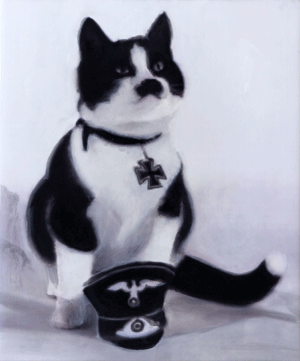
A particularly recognizable and recurring motif in Lisa Strömbeck’s art is animals – with the focus on cats and dogs, while more general thematic aspects are the feeling of loneliness, the relationship between humans and animals, and the quest for closeness and love through the existence of the pet.

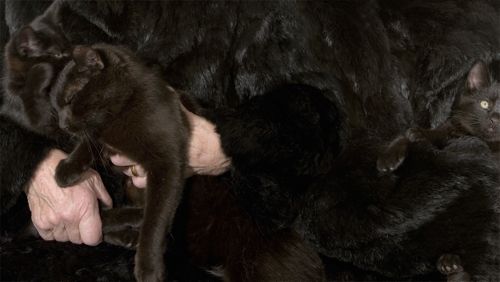
The solo exhibition In Your Hands presents the staged photo series Uniform. Uniform shows various pets being cuddled by their fur-clad owner. The highly cropped composition of the photograph makes it almost impossible to know where the human being ends and the animal begins, since the fur is so like the animal’s in both colour and texture. The boundary between the intimate and the claustrophobic seems hard to detect, and this gives the works aspects of love and closeness versus brutality and tenderness. It is an old saying that a dog often looks like its owner, but in the series Uniform Strömbeck tries to show the viewer that the opposite can equally be the case.

From the photo series Uniform the viewer is guided on into the installation In Your Hands, which contains a film, a fur-upholstered easy chair and a set of paw-like fur gloves. The film make use of several close-ups that give the work an erotic character, and leave the viewer with a sense of wonder and curiosity about the kind of handling it refers to; a handling the viewers can experience on their own bodies throughout the opening on 16th April, when the two participants will be present.

Lisa Strömbeck graduated from the Royal Danish Academy of Fine Arts in 1999 and lives and works in Copenhagen and in Borrby, Sweden. Earlier in the year Strömbeck participated in the group exhibition Derrida’s Katze at Kunstraum Kreutzberg in Berlin with the series Uniform. Besides the solo exhibition at the Martin Asbæk Gallery the gallery will present some of the works from the series Uniform at the art fair Art Cologne on 21st – 25th April 2010 and later at VOLTA6 in Basel on 16th – 20th June 2010.

Martin Asbæk

EBBE STUB WITTRUP

DevilsBridge2

EBBE STUB WITTRUP//Burning in Water – Drowning in Flames

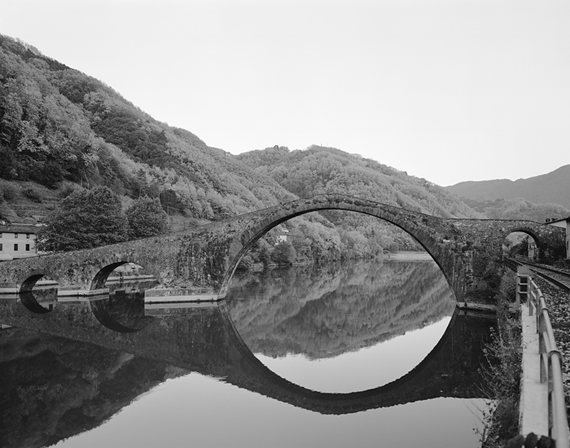
Scattered around Europe there are enigmatic, almost impossibly constructed bridges that hump their way across rivers, abysses and gorges. These bridges have been called Devil’s bridges and form the background for Ebbe Stub Wittrup’s (b. 1973) series Devil’s Bridges, which is being presented at the exhibition Burning in Water – Drowning in Flames at the Martin Asbæk Gallery.

The title of the exhibition, taken from a collection of poetry, is written as a chiasmus, in other words a juxtaposition of elements and words with opposite meanings. The title’s cryptic construction is just as mysterious as the mythological origins of the bridges, which despite their geographical differences are strikingly similar. A recurrent feature of the legends is that the builders had to enter into a pact with the Devil to complete the difficult structures. In return the Devil claimed the first soul to cross the bridge. The residents of the town therefore tried at first to fool him by sending pigs, goats and other non-human creatures across the bridge – but in vain.

The series Devil’s Bridges consists of eight photographs in black and white taken with a technical 4×5” large-format camera to enable an accurate perspectival reproduction. The pictures were shot at sunrise or sunset, when everything lies in shadow. Technically, the light is gauged according to the darkness, which means that the sky becomes bright and the bridge appears more clearly.

Besides the eight picturesque black-and-white photographs, the exhibition presents a 3-minute newly produced 16 mm film played out at the bridge of Céret entitled The 3rd Person, a neon work that bears the title of the exhibition, and half a meteorite


Ebbe Stub Wittrup

Martin Asbæk