Opening tomorrow:::
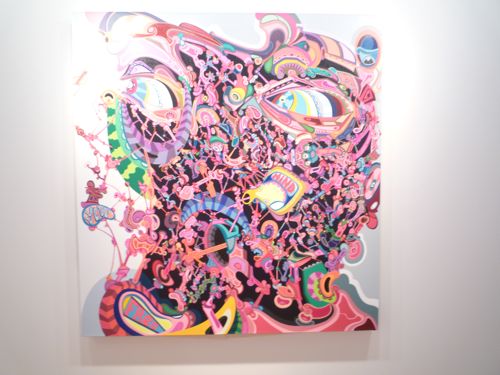
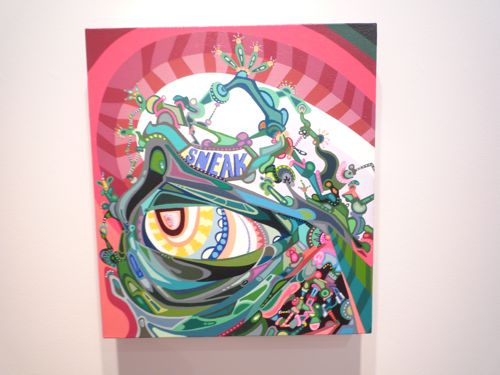
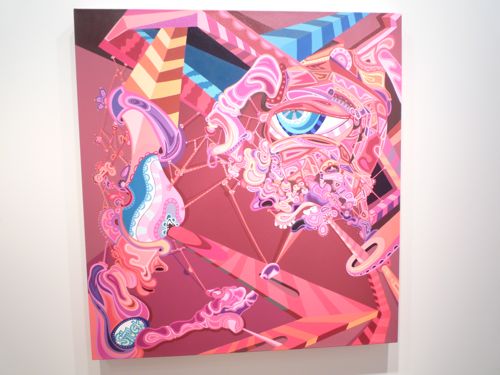
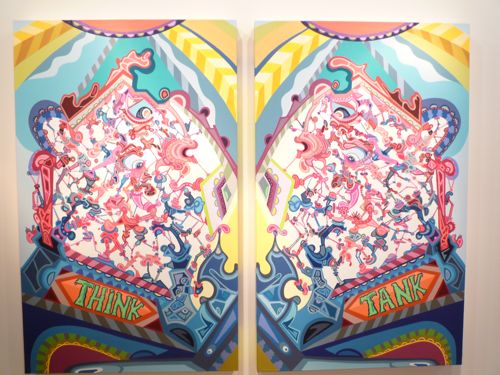
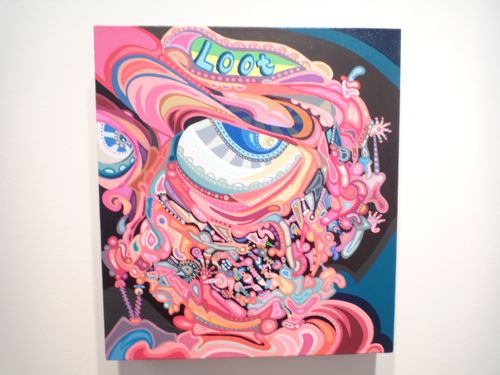
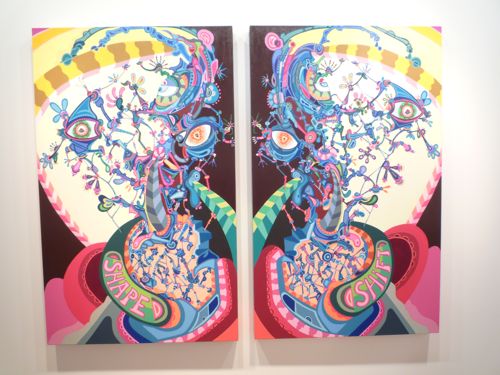
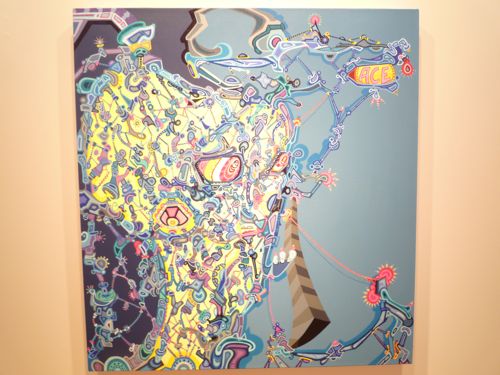
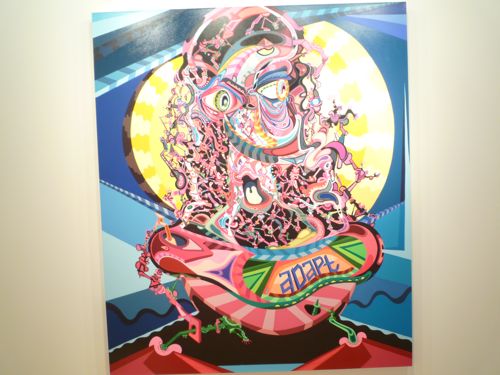
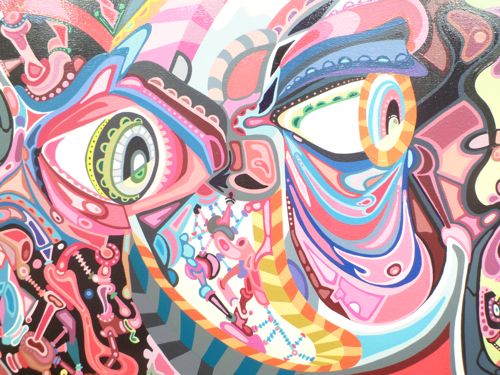
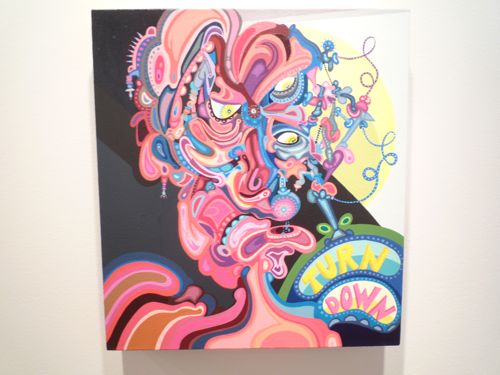
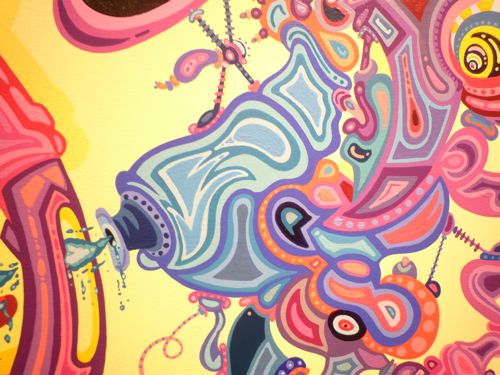
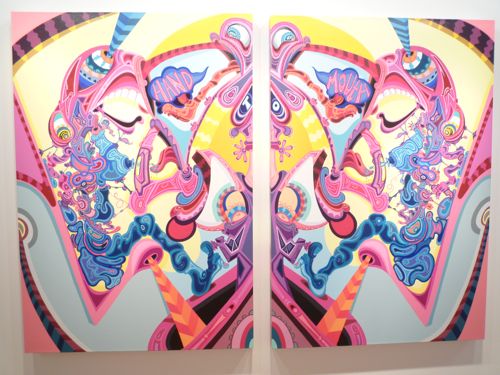
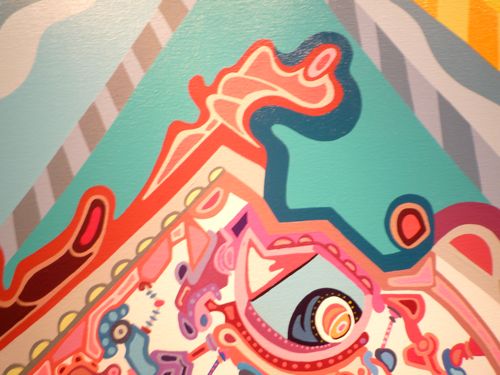
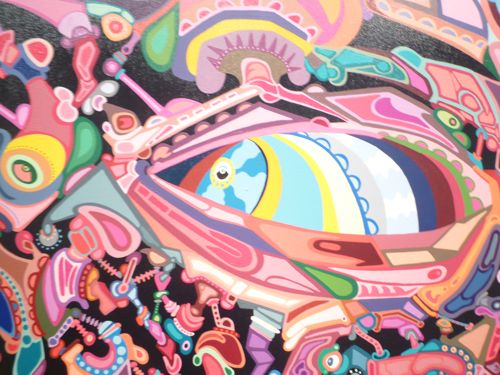
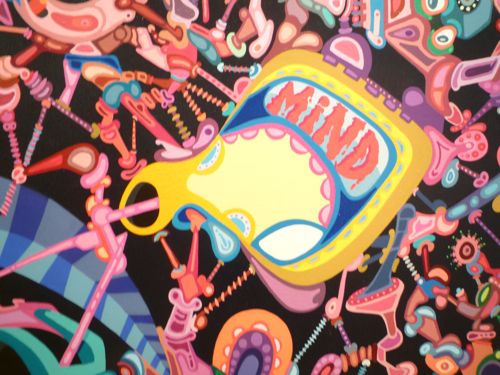
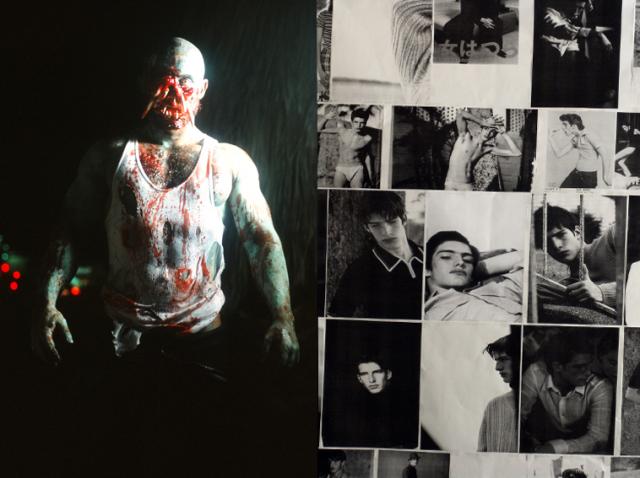
Javier Peres is pleased to present Bruce LABRUCE’s first solo show with Peres Projects in Berlin. “LA Zombie: The Film That Would Not Die” will consist of new works on canvas and the European sneak peak of LaBruce’s most recent film, LA Zombie, starring Francois Sagat.
Now I remember why I love filmmaking. What other pursuit allows you to experience despair and jubilation all in one day, and twice over? Jason picks me up in his trusty Datsun and we head for the lofts on Wilshire where the production office is. The air-conditioning there is broke and with all the guys staying there with no openable windows it’s getting pretty funky. Because the big car crash scene has been changed to a location in Topanga Canyon to be shot on Sunday night, we have the opportunity to shoot another full day of Francois in various locations in LA both dressed as a homeless person and as an alien zombie. Sometimes disaster can turn into advantage.
We did have an awesome, experienced First A.D. in place, but he dropped out about a week before shooting when he got a paying gig. A lot of the people who have volunteered to work on this project for little or no money are dropping off like flies because they just can’t afford to turn down other work if it becomes available. I suppose it has something to do with the economy. I guess the economic disaster also explains why there are so many more homeless people than I’ve ever seen in LA. Anyway, without a real First A.D., the shoot is pretty chaotic today. Laszlo and I are basically doing it ourselves, which is a little distracting. At least we have walkie-talkies and GTS, which makes transportation and finding locations a lot easier. So we head out this morning with our little convey communicating with ten-four good buddies and copy thats.
The first location has sexy homeless Francois gleaning along a chain link fence down on a street that overlooks downtown. I was inspired to play up the homeless aspect of the character by watching Agnes Varda’s “The Gleaners and I” for the first time recently, a meditation on those who pick up waste and garbage and basically pick clean the bones of society. Actually my last film, Otto; or, Up with Dead People, was also about a homeless zombie, partly inspired by Varda’s movie “Vagabond”. So I guess I’m pretty much stuck on one idea, except this time it’s going to be a full on porno. How do you like them apples…
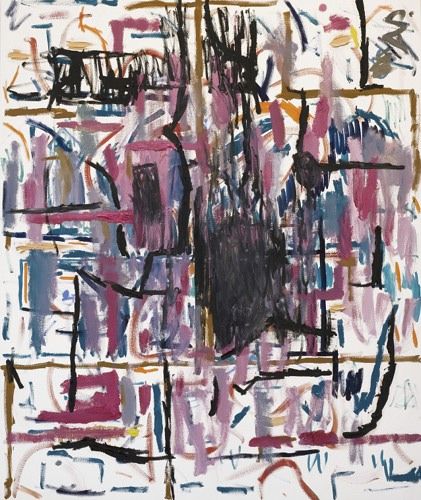
Kavi Gupta Gallery Berlin is proud to present the debut solo exhibition of painter Patrick Alt. Although the gallery’s inaugural exhibition was last September, Alt’s daft exhibition title – “I Open Up The Gallery” – relates to a figurative suggestion rather than the exhibition’s actual vernissage; Alt’s exhibition is one to naively rediscover the space anew, in the same sense that Alt approaches his work as a painter. Included in the exhibition are a suite of the artist’s abstract and bold oil canvasses as well as few painted bought objects installed throughout the gallery. Shot from the hip, Alt perpetually creates works that balance between the artist’s reasoned and developed conceptual disciplines and one’s will to make a new, heartfelt, and expressive work of art. The works’ self-criticality arises from Alt’s radical sense of trepidation, one that questions how an artist is able to break stride with their past and begin again.
Patrick Alt (b. 1976 in Frankfurt am Main) is currently completing his studies at Frankfurt’s Städel Schule under Prof. Michael Krebber. Most recently Alt’s work has been included in a group exhibition (Adrian Buschmann, Henning Straßburger, and Alt) at Galerie Fiebach & Minninger in Köln. Alt has also spent the past year making shows across continental Europe with the artist group Vandel (Philipp Schwalb, Henning Straßburger, Christian Rothmaler, Jannis Marwitz, and Alt). The group has made a series of exhibitions under their collective title, most recently at the AtelierFrankfurt in Frankfurt am Main and at Marks Blond Project in Bern, Switzerland, and also listed in the Watchlist of the July issue of German collector magazine, Monopol. Alt lives in Frankfurt am Main; he maintains a studio there and in Berlin.
One well known psychoanalyst once said: in order to make a book disappear you don’t have
to destroy it – simply take it out of its place in the library and insert it somewhere else, be it
only several bookshelves away. Physically it will remain right at hand, but for anyone
unaware of this, the potential sites and times of the books disappearance will be endless. Only
a madman could start scanning the library book by book in order to find the missing
oeuvre.
Yet there is another possibility, strangely corresponding to the one just mentioned: the
possibility of accidentally finding a certain book which does not belong to the library. A book
which coexists with the whole structure without in fact having a rightful place in it. How
should one read such a book? How do you tell apart the necessary from the contingent or the
text from the context in this instance? Do the underlined sentences form a secret message? Do
these greasy fingerprints belong to the character who sneaked this mysterious book into the
library? Maybe the whole narrative of the work was conceived only to distract the reader
from something much more important? Are you in the book once you touch it?
In the case of
the displaced book a subtle gap is demonstrated. This gap is between the real (in this case, the
books) and the symbolical (the library). Once a book is erased from the symbolical order its
reality is also destabilized. Yet how is it with the book which is in your hands but not in the
register? There is no gap in this case – the book missing from the symbolical order still affects
the latter. A tangible object intrudes into the sphere of ideas without itself becoming an idea.
Apparently, the story begins in the middle as usual.
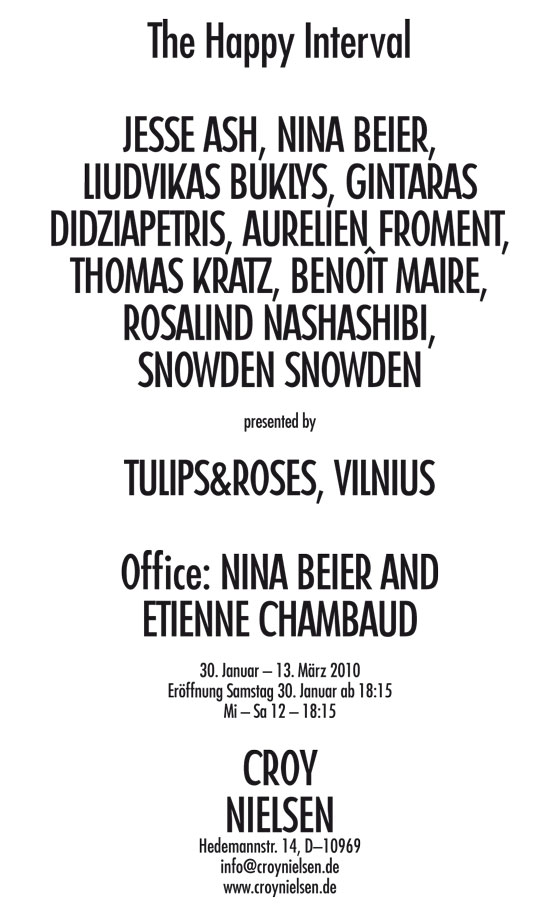
Artists:
Jesse Ash, Nina Beier,
Liudvikas Buklys
, Gintaras Didžiapetris
, Aurélien Froment
, Thomas
Kratz,
Benoît Maire, Rosalind Nashashibi
, Snowden Snowden.
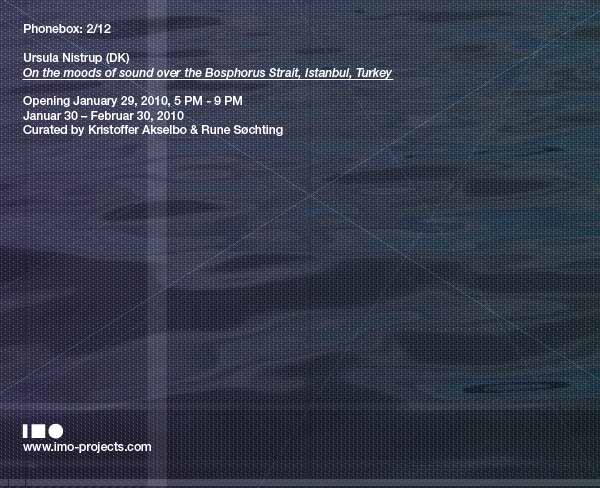
Ursula Nistrup presents a brand new work entitled On the moods of sound over the Bosphorus Strait, Istanbul, Turkey. The sound work is produced for the exhibition space Phonebox at the artist-run gallery IMO. Phonebox is located in a former phone cabin, which will serve as an intimate exhibition space with room for only one person at a time. Here the public is invited to experience the sound work On the moods of sound over the Bosphorus Strait Istandbul, Turkey from January 29 – February 10.
Taking photography and architecture as a starting point, Ursula Nistrup examines the relationship between space and spatial representations, in particular the relationship between sound and space. Her new work On the moods of sound over the Bosphorus Strait, Istanbul, Turkey is based on recordings of horn from ships that daily maneuver the Bosphorus Strait. The multiplicity and tonality of the horns evoke the sound from the orchestra pit in a concert hall before the beginning of the concert. The motif of a unique and unintended “concert” emerges and with it the question of the relation between space and listener. Ursula Nistrup has studied at Glasgow School of Art (MFA) and CalArts.
Ursula Nistrup’s work is the second in a series of sound-based works presented in Phonebox at IMO in the first half of 2010. The series is titled Sounds Up Close #1-12 and is curated by Kristoffer Akselbo and Rune Søchting. It is the intention to present a number of important artists who work with sound as a medium. The different pieces reflect a broad variety of approaches to the work with sound as medium. Over a period of six months a total of twelve pieces will be presented, each for a fortnight. Some of the up-coming artists in Phonebox are Alejandra and Aeron (ES/US), Ultra-red (US) and Jio Shimizu (JP).
Phonebox has earlier served as a phone cabin for the employees at Carlsberg. During the next six months the space, which is acoustically isolated, will function as a unique frame for display and reception of sound-based works. Moreover, the space itself will play an important role in the conceptions of many of the presented works.
Otero Plassart is pleased to present Bulgarian artist Konstantin Bojanov’s debut LosAngeles exhibition: Fears, Obsessions, and Dedications.
For this showcase Bojanov created ten new works that explore the idea of fragility, decay, and mortality through a medium of industrialized objects, handcrafted metals, and other materials that embody permanence: bronze, brass, stainless steel, glass, marble, and gold.
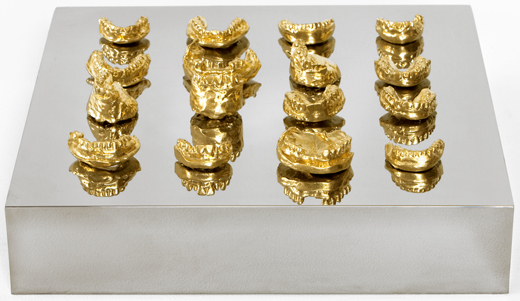
In What is On The Dinner Menu James Lee Byars? Bojanov presents three menacing gold-plated objects: a bone mallet, a bone saw and a vaginal speculum, placed in red-chromed platters that sit on a stainless steel table. What Teeth are You Wearing Mr. James Lee Byars? shows sixteen gilded casts of decaying human teeth displayed on a mirrored pedestal.
For Fear of Falling and Fear Of Drowning, Bojanov incorporates unlikely elements: a hand-polished Harley Davidson engine and a taxidermist’s coyote are joined to iconic symbols of minimalism such as mirrored cubes.
In this exhibition Bojanov expands on his previous works, more specifically his long-standing fascination of pivotal 20th century artists James Lee Byars, Yves Klein, Constantin Brancusi, and Marcel Duchamp. However, he does not attempt to reproduce nor quote these artists. Rather, because they have melded with Bojanov’s subconscious of artistic thought, they have become a part of the fictional narrative of the show.
Bojanov was born in 1968 in Bulgaria, and currently lives and works in New York. His work has been exhibited at various international institutions that include Haunch of Venison in Zurich, the Shanghai Contemporary in China, and Eli Bank Gallery in Bulgaria, in addition to the Art Today Association Center for Contemporary Art in Plovdiv, Bulgaria. Bojanov is also an accomplished filmmaker with his 2001directorial debut in the short film, Lemon is Lemon. His films have received numerous awards and have been screened in over 40 international film festivals. He is currently working with Shilo Films on his first feature film, Avé.