ALBUM

braskartblog

Album is an exhibition comprised of new and existing works by 17 artists currently studying on the Royal College of Art’s Photography MA course. Working across the disciplines of photography, film and video, new site-specific works, which seek to respond to the particularities of the surrounding area and Wolstenholme project space, will also be produced.

Whilst the exhibition does not seek to tie individual artists together via an overarching thematic structure, a unified intention to create and reconstitute existing works, in relation to the project space, is common to them all. Intrigued by the prospect of exhibiting in an unconventional gallery space, the decision to show at Wolstenholme was made, by the group, in order to allow a reciprocity of influence to take place.

For Rebecca Court this has enabled the development of a site specific work across the buildings exterior, and for Tom Pope the interior network of doors provides a framework for the production of a work in which the site visitor will be made to perform. For others presenting still or moving image works the removal of pieces from the context of an ostensibly neutral white cube, provides a unique opportunity for a renewed or unique reading to take place. Similarly, the site itself will, in hosting the collection, be subject to a process of transformation and re-reading.

Album is part of the Independents exhibitions programme that runs parallel to the 2010 Liverpool Biennial. On Saturday 18 September at 1pm, Album curator Morgan Quaintance, an MA student from the RCA Curating Contemporary Art (Inspire) course and the exhibiting artists will give a talk about the work in the exhibition.

The RCA Photography Department has a world-renowned reputation for providing a critical and educational environment in which students can develop as artists with photography at the core of their practice. Alumni of the course include successful practitioners working in both fine art and the commercial sector, including Alison Jackson, Bob Carlos Clarke, Sophy Rickett, Hannah Starkey, Paul Smith, Tom Hunter and Idris Khan.

RCA Album

Aaron Rose //

braskartblog

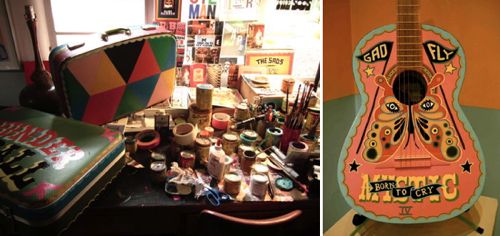
With the solo show „TROUBLE“, Circleculture Gallery presents colourful „object paintings“, which give very personal and direct insights into Aaron Rose´s world. Aaron Rose is perhaps best known as a curator. With his touring show Beautiful Losers and the documentary of the same name, he brought underground artists such as Harmony Korine, Barry McGee and Shepard Fairey to public attention, championing a DIY aesthetic informed by their various backgrounds as skaters, punk rock fans and graffiti writers.

For this show he has a particular obsession: painting on suitcases. “Suitcases from the 50s to 70s were manufactured in such interesting color palettes – these incredible mustard yellows and army greens,” he says. Rose calls the works (some of which are stuffed with surprise goodies for buyers to walk away with) “object paintings,” displaying them in the spirit of Duchamp. Art historical references aside, the show’s conceptual slant is psychological, personal even. “It’s my baggage,” says Rose. “The exhibition is going to be very much a confession, what all my problems are.”

Circleculture Gallery

With As if //

As_if_times_under- CARD+4mm-2mm

With As if, Carla Arocha – Stéphane Schraenen offer us the double-edged sword that is a frequent feature of their work. The off-hand nonchalance of the title, now a loaded statement in the popular vernacular, might indicate a certain cynicism or world-weariness; a jaundiced eye cast in the direction of art and its efforts. But, like so many other aspects of their work, this is something of an illusion and an allusion.

The title equally refers to the formal and material nature of their new work itself. Within the work of Arocha – Schraenen, simile and facsimile are often content; the nature of an image and its similarity or distance from the perception of that image. In the works that play with layering and blurring the lines between what is, in reality, a solid surface and what is only a reflection –or the facsimile of a tangible material – Arocha – Schraenen join the dotted lines between Modernism’s approach to something nearing an abstracted form of representation and the age old mimetic thrust of art drawing upon observations of the world around us.

In As if this intersection between science and art’s mimetic drives is once again foregrounded. Each work is actually a moiré of one form or another, whether manifesting as a sculpture or photographic work. Most immediately associated with textiles, a moiré is also a scientific phenomenon: an interference created when two grids are superimposed at an angle or where their mesh sizes differ. The nature of the moiré phenomenon connects textile traditions with the photographic and reprographic process and naturally lies within Arocha – Schraenen’s explorations of how images are constructed. In this particular case, their interest examines how moirés manifest in static objects transmute into a perception of movement. Yet, the works also conversely evoke a sense of scientifically explained moirés that occur when an image-making device – for example a television camera- attempts to transmit an image of certain patterned static objects due to the sampling limitations of the medium itself. Just as an image may prove illusory, these works remind us more specifically that one way in which an image might prove to be different from its perception is in terms of movement. Exactly what is moving and what is still within each situation?

–         Text excerpted from essay by Ken Pratt


Carla Arocha (Venezuelan, born Caracas 1961, lives Antwerp, Belgium) and Stéphane Schraenen (Belgian, born 1971, lives Antwerp, Belgium) began collaborating publically in 2007 with their exhibition Mauraders at moniquemeloche. Previously, Arocha has had solo exhibitions at moniquemeloche in 2004 and 2001. In 2009 Carla Arocha – Stéphane Schraenen permanently installed the City of Chicago commissioned artwork 24/7 at the CTA’s Red Line Howard Station.  The artists have had solo exhibitions at the FRAC Auvergne in Clermont-Ferrand, France, the Kunsthalle Bern in Switzerland, and the MUHKA in Antwerp, Belgium and have work in a number of prestigious institutions including the Art Institute of Chicago, IL;  the F.R.A.C. Auvergne, Clermont-Ferrand, France; the Fundación Banco Mercantil, Caracas, Venezuela; the  Museum of Contemporary Art, Chicago; the Museum of Modern Art, NY; the Museum van Hedendaagse Kunst Antwerpen (MUHKA), Antwerp, Belgium; and the Stiftung, Bern, Switzerland.

Monique Meloche

ESKO MÄNNIKKÖ

Blues Brother 1

Upon first glance, the faces in Männikkö’s new series appear ghostly, hauntingly expressionless and discoloured, calling to mind the blue pallor of a drowning victim or the blackened skin of a coal miner returning from a day at work.
For Blues Brothers, Männikkö photographed the statues of Milan’s famed Cimiterio Monumentale (Monumental Cemetery), known for its artful crypts and honourable dead. Strikingly human, the subjects of Männikkö’s series are in a state of beautiful yet disturbing decay, weathered by years of exposure to the elements. In one image, the original patina of brushed metal is still visible, while green moss begins to creep around the features of the sullen face; in another, a carefully down-turned mouth is rendered into an even more tortured expression by the tinted oxidation of the figure’s chin and facial hair. Männikkö’s portraits show a poignant vulnerability, and the marred faces seem to betray an animated life once lived; they become death masks sheathed in the elements of nature, the very forces of which cast a life cycle onto the presumed permanence of the memorial stone relief and bronze work.

As in his previous series, Männikkö has mounted the photographs from Blues Brothers in heavy, often found frames, a display tactic more readily associated with classical painting than contemporary photography. Framed in vintage wood, Männikkö’s photographs do not read as harbingers of truth; rather, the specific presentation of the images blurs the documentary quality inherent to photography, furthering the ambiguity of the depicted faces. In this new series, Männikkö transforms sculptural objects into men, producing characters wrought with sorrow, suspended between life and death.

The figures in Blues Brothers are without a setting; their faces occupy the entirety of the frame and they are shown against a neutral black or grey background. This is a departure from Männikkö’s earlier work, in which the setting of the photograph sheds important light on the depicted characters. In his series of Finnish bachelors, for example, Männikkö shows the solitary men in their homes, surrounded by personal objects in a seemingly everyday arrangement. Borrowing from classical portraiture, these objects serve as attributes for the men themselves, cluing the viewer in on different aspects of the subject’s life and providing the means by which a narrative might be strung together. For another series, MEXAS (1996-97), Männikkö photographed people living in the United States near the Mexican border, set against the backdrop of their own homes or the local landscape. When aligned through Männikkö’s lens, the subject’s faces and their surroundings build a myth of belonging, of arriving at a place called home, yet still tinged by an ambiguous air of discomfort or displacement.

The ambiguity of truth in Blues Brothers and MEXAS also calls to mind Männikkö’s previous series, Harmony Sisters (2004-ongoing), in which the artist photographed fragments of live animals—a mouth, a hide, an eye, etc.—documenting the outer anatomy of an array of creatures. The resulting images provide a macro view that is rarely straightforward: a lolling tongue could belong to a cow or horse, a roll of skin and patch of fur to a variety of beasts. In this way, Männikkö’s works possess many truths that demand to be weighed against one another.

Männikkö himself has said that the picture confirms whether or not an object is real. Indeed, after careful inspection, the men of Blues Brothers reveal themselves to be neither dead nor alive; rather, they emerge as very real sculptural objects, subject to the inevitable process of aging, much like the men whose graves they mark.

Esko Männikkö was born in 1959 in Pudasjärvi in the northern part of Finland. He lives and works in Oulu. In 2008 he was awarded the prestigious Deutsche Börse Photography Prize. The same year he presented “Cocktails 1990-2007” at Millesgården, Lidingö, Kulturhaus, Lulea and Bomuldsfabriken Kunsthall Arendal. Other solo exhibition include Finsk-Norsk Kulturinstitutt, Oslo, 2004, the Hasselblad Center, Gothenburg, 1999, the Malmö Konsthall, 1997, as well as Portikus, Frankfurt/Main, De Pont, Tilburg and Lenbachhaus, Munich, all 1996. He has taken part in numerous international exhibitions including the Venice Biennial, 2005, Johannesburg Biennial, 1997, São Paulo Biennial, 1998, “Contemporary Photography II: Anti-Memory,” Yokohama Museum of Art, 2000, “Beyond Paradise,” Shanghai Art Museum, 2003, Liverpool Biennal, 2004, “SEEhistory. Der private Blick,” Kunsthalle z u Kiel, 2005, and the travelling exhibition “Investigations of a dog,” organized by the Fondazione Sandretto Re Rebaudengo (2009-2010). Männikkö had numerous solo exhibitions at Galerie Nordenhake in Stockholm and Berlin.

Nordenhake