New stuff & some old stuff (End of 2009)











New stuff & some old stuff (End of 2009)
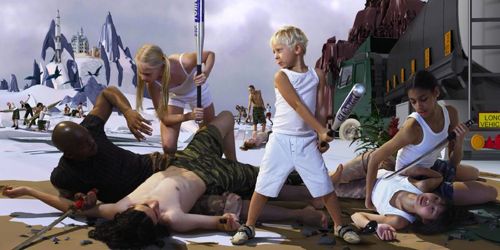
The current economic crisis, its consequences and the mediation for the salvation of capitalism is giving a “fake feeling that capitalism has failed and that it will be replaced by a new social form more concerned with justice.” Behind this false hope, capitalism is just changing its face, masking its exploitative nature and inventing new forms of oppression, updating itself for the 21st century. This is the point of departure of the show that brings together disparate art practices by artists in different media who thematize the short-circuiting flow of capital. To organize this show in the site of a commercial gallery is to emphasize the importance of the status of politics of aesthetics today. The question can be raised as following: is art capable to intercept this closed circle or not? The idea is not to simply chart the rise and fall of excess culture but to address the modes of production in late capitalism in relation to artistic production and consumption that brings to the series of busts and booms in the art markets.
Acknowledging radical critical thinking today that researches and addresses the contemporary role of capital in (de)regulating all social processes, this exhibition has a goal to provide a (partial) insight into critical interventions in the structure of contemporary capitalist societies, aiming at shedding light to commodification of art. Art in this show does not only depict excess but points to paths away from the spectacular to the realm of “slight offense,” or “minimal radicality.” This is where, at the beginning of a new decade, the place of subversion lies.
Mathieu Matégot
Johann König, Berlin is proud to present a selection of pieces by Mathieu Matégot. The exhibition takes place during the gallery exchange Berlin-Paris and results from the collaboration with jousse entreprise, Paris.
Mathieu Matégot is undoubtedly a forerunner of contemporary design. His involvement in innovative techniques and original forms makes him one of the more special figures of the 1950s, stamping his imprimatur on French style in that fertile post-war period.
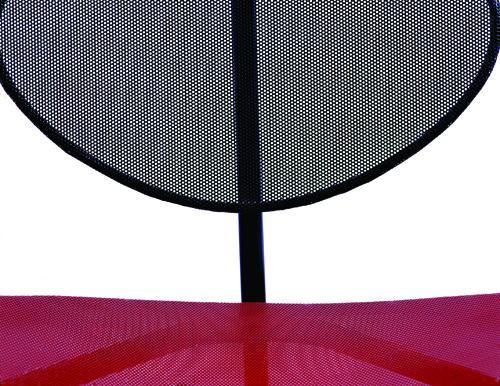
In the 1940s, and quite off the cuff, he introduced the notion of creation and aestheticism into the making of humdrum objects, with a particular fondness for rattan and metal. He lent these objects a one-off form, which made them all identifiable. His brilliance lay in the fact that, before anyone else, and from 1945 onward, he used perforated sheet metal in a quite novel way. This was a material he had discovered during his captivity in Germany. By inventing a new technique, he created a new matter. First, he perforated the sheet metal in a conventional way with clover designs, then with small square and round holes. In 1952, he christened this pierced grid-like network, which was usually painted black, with the pretty and evocative name of “rigitulle”. He developed a machine that could bend, fold and fashion sheet metal like a piece of fabric, which, in turn, gave him a great deal of freedom of expression (cf. the “Java“, “Soumba“, “Bagdad“, “Satellite“ series, etc…). And his creativity did not stop with the way he used metal: he also made use of rattan, brass, Formica, glass (sometimes engraved), different species of wood, as well as fabric and leather, in an infinite number of variants.
For the other distinctive thing about Mathieu Matégot resides in the amazing production of small pieces of furniture and everyday objects, somewhat old-fashioned but always delightful, for which he managed to invent “modern” forms and lines (trays, wastepaper-baskets, magazine racks, glass holders, flower-pot holders, occasional tables etc..). These pieces were exhibited at major fairs and shows (Salon des Art Ménagers, Salon des Artistes Décorateurs, Arts de la Table), then distributed in editions of 200, on an exclusive basis, to decoration shops.
But it was in the most important models – lamps and lights, seating, tables – made for cata€logues and commissions, in very limited editions of 6-8 – that Mathieu Matégot’s talent really had free rein. Pieces with more finished structures, at once powerful and using curves, with clean, airy lines, among which we find the masterpieces which still act as references half a century later – like the three – legged “Nagasaki” chair, the “Copacabana” armchair with its curved metallic structure, and the “Santiago” armchair (with the seat and back made of parallel strips in perfo€rated sheet metal).
Born in 1910 in Hungary, but of French nationality, Mathieu Matégot was an officer of the Order of the Arts and Letters. He had started as a decorator of the theatre, but in 1939 he developed an interest in tapestry. In 1949 he designs numerous pieces of furniture in perforated metal. Matégot launches himself in a career as decorator and furniture designer. In the 60’s he accepted a post of professor of art at the prestigious l’Ecole des Beaux Arts at Nancy. Mathieu Matégot ended his life in February, 2001 at Angers, France. He was 90 years old.
Roskilde rocks::::::…….









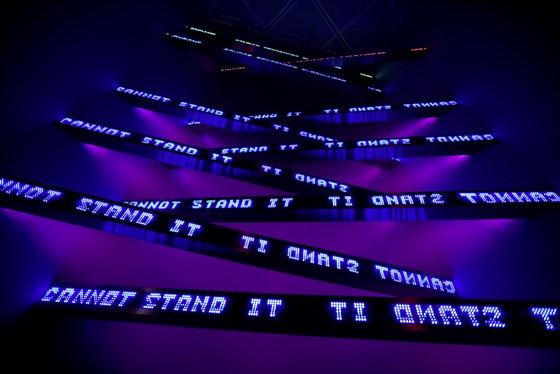
Artist Talk at Fondation Beyeler
Jenny Holzer in conversation with Jacques Herzog, Herzog & de Meuron Architects
American artist Jenny Holzer (b. 1950) is one of the most significant artists of our time. She has held exhibitions and presented art projects worldwide and won many awards, including the Golden Lion at the Venice Biennale (1990).
Jacques Herzog, together with Pierre de Meuron, is founder of the Swiss architecture practice Herzog & de Meuron. The architects gained world-wide recognition for, amongst others, Tate Modern in London (2000), St. Jakob-Park in Basel (2001), Allianz Arena in Munich (2005) and the Olympic Stadium in Beijing (2008). In 2001 they were awarded the Pritzker Prize and in 2007 were recipients of the ‘Praemium Imperiale’.
Fondation Beyeler is presenting Jenny Holzer’s first large exhibition in a Swiss museum. Incorporating texts she has written since the late 1970s, the show comprises important objects from various phases of Holzer’s career since the 1980s. The focus is on recent works, some of which have never before been shown in Europe. On view are paintings and sculptures, as well as her famous LED installations, containing compelling combinations of overwhelming visual effects and memorable texts of a poetic, socio-critical, and political nature. The presentation is supplemented by a selection of works the artist has chosen from the Beyeler Collection (A. Giacometti, P. Picasso, K. Malevich, and F. Bacon). In addition to the museum space, the exhibition also extends outdoors to the public domain. Spectacular light projections on key buildings and sites in Basel, Baselland, and Zurich will be on view on special nights.
Conceived in close cooperation with the artist and the MCA, Chicago, the exhibition was curated by Elizabeth A.T. Smith and Philippe Büttner.
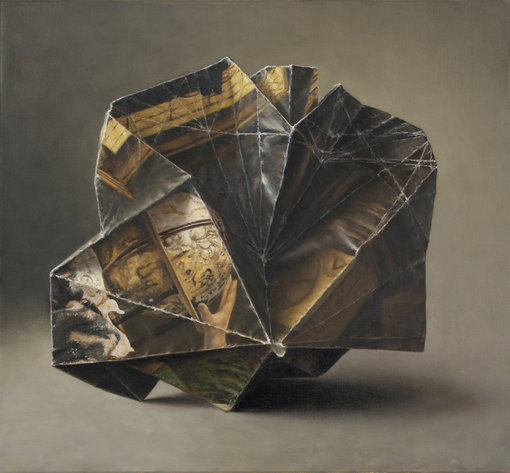
Hales Gallery is pleased to present Filippo Caramazza’s first solo show at the gallery.
The title of the exhibition, The Flutes of Impossible Shepherds, refers to a quote from The Book of Disquiet by Fernando Pessoa, the Portuguese poet and writer, who utilized the literary device of Heteronymy; the creation of one or more imaginary characters created by a writer to work in distinctly different styles.
Caramazza calls upon the deep reserve of painting itself, not as relics of the past, or shards, but rather as reminders of the endlessness of signification embedded in these works. Masterpieces from the past are disassembled and reassembled, occasionally stripped bare to just one element. Many become beautifully painted still life of props or origami made from the pages of past auction catalogues. Others are trompe l’oeil of studio walls with taped postcards or blu tack and some become folded canvas, lumpy and obtuse.
We are presented with simulations of the almost endless catalogue of a museum of the mind, a veritable gallery of the image. The adventure of the image is both cast as entanglement but also as the potentiality of release, it is on this edge that the work steers its course. Each series appear to announce their unique posture in regard to painting and appropriation. It is not always clear what is at stake in this; is it a case of humour, cultural exhaustion, irony, or even a procession of despair?
Filippo Caramazza graduated from the Royal College of Art in 2008.