Tony Oursler

braskart

Experimental video artist
It is with great pleasure that Faurschou Beijing presents a solo exhibition by the American video artist Tony Oursler, his first exhibition in China.
Since the mid-1970s Oursler has been a pioneer in New Media Art, and today he is one of the very biggest, most experimental and innovative artists working in the field of the video medium. The exhibition will introduce the Chinese public to a survey of projected pieces from the early 90s to the present that will give a strong impression of this great artist’s work.

Unique idiom
Tony Oursler has become well known for his unique video and installation works, which combine spoken text, performance, moving images and sculptural objects. Unlike other video artists Oursler does not only project his works on a uniform surface but projects his video images on to dolls, balls, architecture and other surfaces such as treetops and clouds of steam. It has been said that the artist has freed the video image from the “box.”

The Human Head
In this survey of works from the past two decades the curatorial focus is on the head of the human body. All the works in the show are based on the head and the notion of the head as the permeable center of consciousness. The work addresses the ebb and flow of elements such as light, smoke, thoughts, impulses, language, voice, memory, which interact with this central icon.

The Works
The viewer is greeted by “Doll”, one of Oursler’s first breakthrough projections on rag dolls from the early 90s. The classic figurative sculpture is fused with a projected face, forming a hybrid between art and cinema. The little talking figure tests the viewer’s empathy by challenging his passive role in art viewing.

Entering the exhibition one has to pass through “Cigarettes” a series of oversized, tubular screens with high-definition projection. The effect is that of a smoldering, virtual forest of various Western brands of cigarettes. The viewer’s decision to indulge, or not, in various compulsive activities is called into question. This work also has further philosophical ramifications, including the pros and cons of progress as the columns seem to transform into architecture, or an industrial skyline.

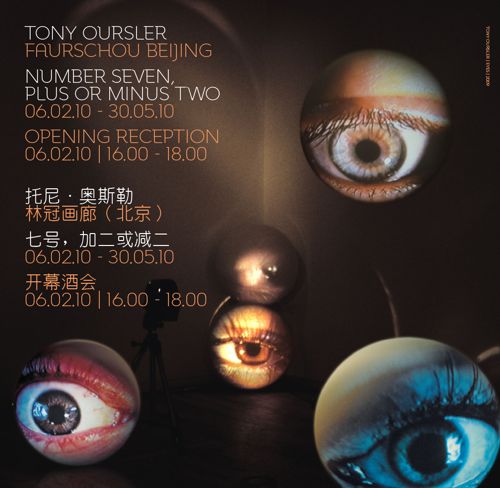
In another installation, “Eyes”, large blinking eyeballs are floating like independent planets in the universe. With its point of departure in the history of the camera obscura, first mentioned by the Chinese poet and scientist Shen Kuo (1031-1095), this installation points to the eye as an anatomical analogue of our desire for escapism through technology.

Continuing the exploration of technology, media and the viewer’s fantasy, the installation “FX” (the abbreviation for special effects in the movie industry) is a multi-projection of a human head lost in a blaze of flames and explosions. Inspired by blockbuster cinema and terrorist activities, the work begins with an ironic, humorous premise: What would happen if the explosion was extended in time? In this installation something that would take place in a fraction of a second is stretched out in time, and the viewer can enter into a dialogue with an inferno.

Ending the exhibition on a humorous note, Oursler meets the viewer’s basic need for companionship with “Classic”. A head pieced together as a film collage of eyes and a mouth is uttering absurd sentences and statements. It is very amusing and disturbing too – and points to the way we mould technology to our desires, in the tradition of the “smiley face” and the “avatar” – the 3D representation of the interaction between human and machine.

The Magical Number Seven, Plus or Minus Two
The exhibition takes its title from George Miller’s classic 1956 paper “The Magical Number Seven, Plus or Minus Two” – an essay about the limits on the capacity of human cognition. Psychological experiments have shown that people have a hard time remembering more than about seven unrelated pieces of really dull data all at once. The point of Miller’s research is that for human beings to remember large quantities of information they have to associate memory fragments with the various data.

Technology and Humanity
Tony Oursler’s video installations are influenced by exactly this: his interest in our information and media society and its effect on mankind. The uncertainty that many people feel in connection with the constantly growing flow of information, the fragmentation of the world and alienation from our own bodies and society is a conspicuous theme in many of his works.

Oursler is fascinated by the enormous potential of new technologies, especially those which, like video and film, can get close to reality. Oursler uses technology to imitate human and emotional features – and by associating speech, moving images and objects Oursler creates video sculptures and installations that exhibit a humanity that can easily engage us.

This visually convincing and humorous way of approaching current important social, psychological and existential subjects has made Tony Oursler one of the most important artists in the world today.
Faurschou

“Midnight Matinee,” Gary Simmons

f0317781

In the exhibition “Midnight Matinee,” Gary Simmons uses images of drive-in theater marquees and infamous houses from vintage horror films to reflect on ghosts and abandoned pasts. Simmons has long referenced film, architecture and American popular culture in works that address personal and collective memories of race and class.

The films Amityville Horror, Burnt Offerings, Psycho and The Texas Chainsaw Massacre all have houses that figure prominently, often actively, in the plot. No less haunted are the forsaken drive-in theatres, their elaborate signs and marquees totems to their lost vitality. Combined, the images of architecture and the cinema naturally lend themselves to the movement inherent in Simmons’ drawings and paintings. “Split Personality” is a large wall drawing (scaled to the proportions of a movie screen) that uses an image of the notorious Psycho house split horizontally and inverted as if flickering between frames. The multi-panel drawings create the illusion of movement in their vertical filmstrip format with images repositioned as in stop-motion animation.

Simmons’ distinctive “erasure” technique has been central to his work since the early 1990’s. In their earliest incarnations, Simmons composed compositions in white chalk on readymade chalkboards or directly onto slate-painted walls that he partially expunges and erases by smudging the images with his hands. In recent years, Simmons has adapted the process to canvas using pigment, oil paint and cold wax. Using a black on black palette for the first time, Simmons’ new works amplify the refinement of his technique with subtly textured backgrounds and images drawn and smeared in lush oil paint.

Gary Simmons has been included in exhibitions at the Museum of Modern Art, New York; the Bohen Foundation, New York; the Whitney, New York; the Studio Museum of Harlem, New York; the Museum of Contemporary Art, Chicago; the Hirshhorn Museum, Washington D.C.; the Museum of Contemporary Art, Los Angeles; the St. Louis Art Museum and the Kunsthaus Zürich. He has had work recently commissioned for both the New York Presbyterian Hospital and the Dallas Cowboys stadium. His work is represented in the collections of the Museum of Modern Art, New York; the Rubell Family Collection, Miami; the Museum of Contemporary Art, Chicago; the San Francisco Museum of Modern Art; and the Whitney, New York.

Metro Pictures Gallery

Michael Landy

art_bin

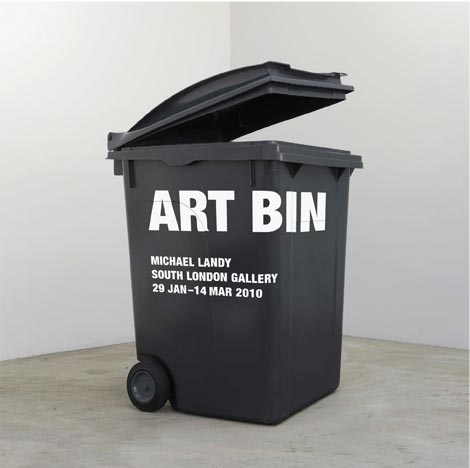
Art Bin is a major new installation by Michael Landy transforming the South London Gallery into a container for the disposal of works of art. Landy famously destroyed all his possessions in his 2001 installation Break Down and this enormous work similarly raises issues around disposal, destruction, value and ownership. Over the course of the exhibition, as people take up Landy’s invitation to discard their art works, it forms what he describes as “a monument to creative failure”. Anyone can apply to dispose of art works in Art Bin by bringing them to the gallery or applying online at www.art-bin.co.uk.

Art Bin

South London Gallery

Bruce LABRUCE

5875

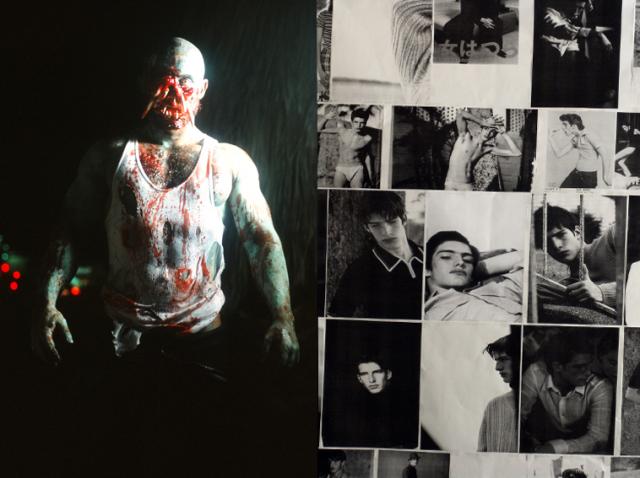
Javier Peres is pleased to present Bruce LABRUCE’s first solo show with Peres Projects in Berlin. “LA Zombie: The Film That Would Not Die” will consist of new works on canvas and the European sneak peak of LaBruce’s most recent film, LA Zombie, starring Francois Sagat.

Now I remember why I love filmmaking. What other pursuit allows you to experience despair and jubilation all in one day, and twice over? Jason picks me up in his trusty Datsun and we head for the lofts on Wilshire where the production office is. The air-conditioning there is broke and with all the guys staying there with no openable windows it’s getting pretty funky. Because the big car crash scene has been changed to a location in Topanga Canyon to be shot on Sunday night, we have the opportunity to shoot another full day of Francois in various locations in LA both dressed as a homeless person and as an alien zombie. Sometimes disaster can turn into advantage.
We did have an awesome, experienced First A.D. in place, but he dropped out about a week before shooting when he got a paying gig. A lot of the people who have volunteered to work on this project for little or no money are dropping off like flies because they just can’t afford to turn down other work if it becomes available. I suppose it has something to do with the economy. I guess the economic disaster also explains why there are so many more homeless people than I’ve ever seen in LA. Anyway, without a real First A.D., the shoot is pretty chaotic today. Laszlo and I are basically doing it ourselves, which is a little distracting. At least we have walkie-talkies and GTS, which makes transportation and finding locations a lot easier. So we head out this morning with our little convey communicating with ten-four good buddies and copy thats.
The first location has sexy homeless Francois gleaning along a chain link fence down on a street that overlooks downtown. I was inspired to play up the homeless aspect of the character by watching Agnes Varda’s “The Gleaners and I” for the first time recently, a meditation on those who pick up waste and garbage and basically pick clean the bones of society. Actually my last film, Otto; or, Up with Dead People, was also about a homeless zombie, partly inspired by Varda’s movie “Vagabond”. So I guess I’m pretty much stuck on one idea, except this time it’s going to be a full on porno. How do you like them apples…


Brue Labruce

Peres Projects

“I Open Up The Gallery” by Patrick Alt

braskart

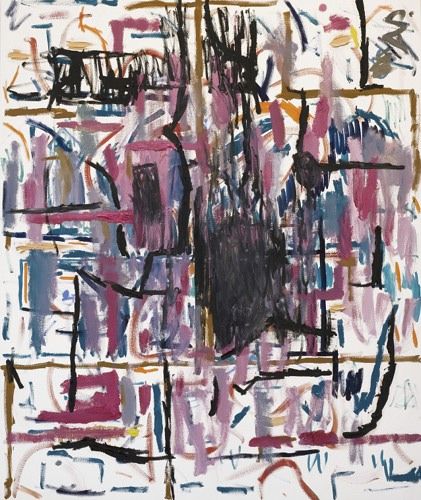
Kavi Gupta Gallery Berlin is proud to present the debut solo exhibition of painter Patrick Alt. Although the gallery’s inaugural exhibition was last September, Alt’s daft exhibition title – “I Open Up The Gallery” – relates to a figurative suggestion rather than the exhibition’s actual vernissage; Alt’s exhibition is one to naively rediscover the space anew, in the same sense that Alt approaches his work as a painter. Included in the exhibition are a suite of the artist’s abstract and bold oil canvasses as well as few painted bought objects installed throughout the gallery. Shot from the hip, Alt perpetually creates works that balance between the artist’s reasoned and developed conceptual disciplines and one’s will to make a new, heartfelt, and expressive work of art. The works’ self-criticality arises from Alt’s radical sense of trepidation, one that questions how an artist is able to break stride with their past and begin again.

Patrick Alt (b. 1976 in Frankfurt am Main) is currently completing his studies at Frankfurt’s Städel Schule under Prof. Michael Krebber. Most recently Alt’s work has been included in a group exhibition (Adrian Buschmann, Henning Straßburger, and Alt) at Galerie Fiebach & Minninger in Köln. Alt has also spent the past year making shows across continental Europe with the artist group Vandel (Philipp Schwalb, Henning Straßburger, Christian Rothmaler, Jannis Marwitz, and Alt). The group has made a series of exhibitions under their collective title, most recently at the AtelierFrankfurt in Frankfurt am Main and at Marks Blond Project in Bern, Switzerland, and also listed in the Watchlist of the July issue of German collector magazine, Monopol. Alt lives in Frankfurt am Main; he maintains a studio there and in Berlin.

Kavi Gupta Gallery

THE HAPPY INTERVAL

brask

One well known psychoanalyst once said: in order to make a book disappear you don’t have
to destroy it – simply take it out of its place in the library and insert it somewhere else, be it
only several bookshelves away. Physically it will remain right at hand, but for anyone
unaware of this, the potential sites and times of the books disappearance will be endless. Only
a madman could start scanning the library book by book in order to find the missing
oeuvre.
Yet there is another possibility, strangely corresponding to the one just mentioned: the
possibility of accidentally finding a certain book which does not belong to the library. A book
which coexists with the whole structure without in fact having a rightful place in it. How
should one read such a book? How do you tell apart the necessary from the contingent or the
text from the context in this instance? Do the underlined sentences form a secret message? Do
these greasy fingerprints belong to the character who sneaked this mysterious book into the
library? Maybe the whole narrative of the work was conceived only to distract the reader
from something much more important? Are you in the book once you touch it?
 In the case of
the displaced book a subtle gap is demonstrated. This gap is between the real (in this case, the
books) and the symbolical (the library). Once a book is erased from the symbolical order its
reality is also destabilized. Yet how is it with the book which is in your hands but not in the
register? There is no gap in this case – the book missing from the symbolical order still affects
the latter. A tangible object intrudes into the sphere of ideas without itself becoming an idea.
Apparently, the story begins in the middle as usual.

Artists:
Jesse Ash, Nina Beier, 
Liudvikas Buklys
, Gintaras Didžiapetris
, Aurélien Froment
, Thomas
Kratz, 
Benoît Maire, Rosalind Nashashibi
, Snowden Snowden.

Croy Nielsen