Tag: US
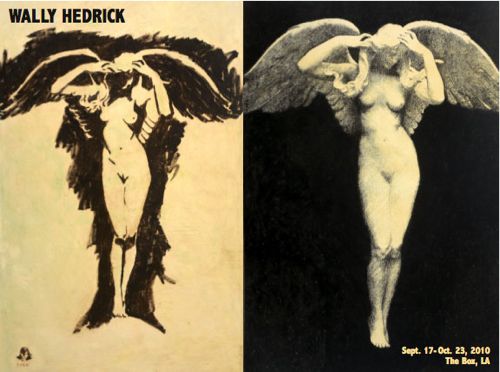
Wally Hedrick
Doubting Thomases
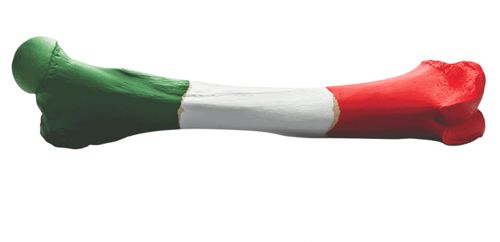
Naturaleza Muerta
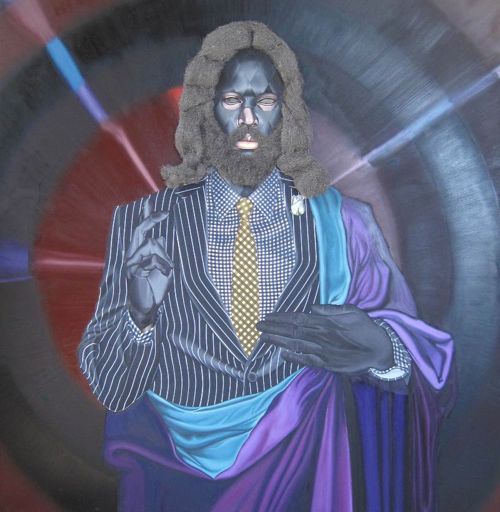
Jeff Sonhouse | Better Off Dead Said The Landlord
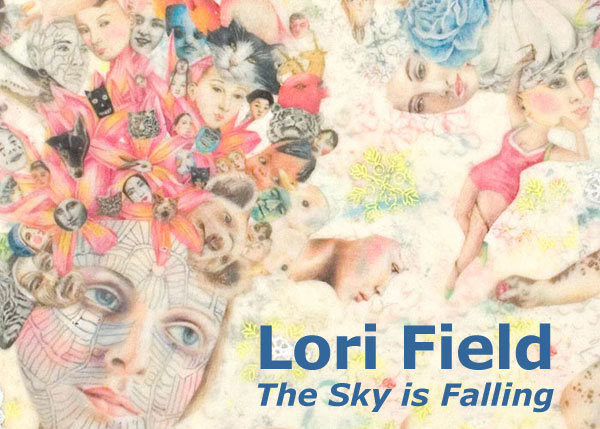
Lori Field @ Claire Oliver
JOHN F. SIMON
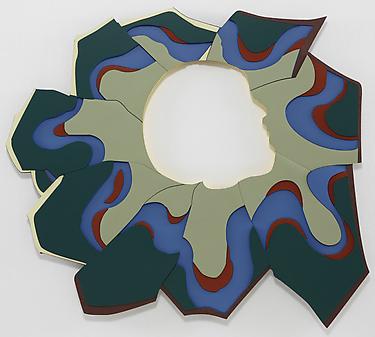
Continuing to experiment with software and robotic fabrication, Simon adds another dimension to the translation of his drawings from the digital to the physical. The new bas-reliefs made of wood and formica in Simon’s current exhibition elaborate on his long term fascination with automated mark making.
In his first exhibition with Sandra Gering Gallery in 1998, Simon showed pen-plotted ink drawings on paper generated from software tools he wrote called “Mobility Agents.” This new body of work relies on similar computer control to realize larger scale pieces. By layering line, color, and material, Simon invites you to “consider how things are defined by what surrounds them.” The innerhole calls attention to the negative space at the center.
The conceptual aspect of the work reflects Simon’s deepening dedication to drawing and understanding the sources of his own creativity. For the past eleven years, Simon has committed himself to a daily practice of drawing through which he observes his own intuitive markings, posting them on iclock.com. He then seeks to codify these improvisations, interpreting the drawings through different media including software, paper and wood. In setting out to automate improvisation through self-observation, he is guided by the practices of artists like André Breton, Jean Arp and John Cage, whose work relies on impulse and chance.
innerhole is John F. Simon, Jr.’s eighth solo exhibition in New York. Born in Louisiana in 1963, he currently lives and works in Orange County, New York. He has an MFA in Computer Art from the School of Visual Arts and additional degrees from Brown University in Providence, RI, and Washington University in St. Louis, MO.
Two works from the innerhole series will be included in the upcoming group show curated by Hubert Neumann, The Incomplete, at Galerie Jean-Luc & Takako Richard, Paris, France. His work is found in prominent museum collections such as the Museum of Modern Art, New York, the Solomon R. Guggenheim Museum, New York, the Whitney Museum of American Art, New York, and the Los Angeles County Museum of Art, California.
Chris Verene

Chris Verene’s first show at Postmasters will present over forty photographs made during the past twenty-six years. This landmark exhibition of documentary storytelling chronicles a group of closely-knit characters from the photographer’s family and their rural Illinois community. The photographer is also one of the characters– his blood bonds and bonds of friendship within the small town are carefully spelled out in simple handwritten captions atop the colorful pictures. Verene’s new book, “Family,” published this summer, contains many of the images on view – it opens with his cousin Candi’s divorce. Candi was made famous when her wedding picture appeared on the cover of Verene’s first book ten years ago. Both husband and wife were fired in the Maytag factory closing described in President Obama’s first address to the United States in 2004 and in the 2010 State of the Union. Theirs is not the only family torn apart by the economic struggles of the country, as Verene documents other similar stories. The exhibition will also bring to light recent developments in the artist’s intimate life, as his young child, Nico, Brooklyn-born and half-Puerto Rican, appears throughout the latest photographs, playing with his cousins and newfound friends in Galesburg. This show will offer an extraordinary, inspiring, hopeful, and sometimes sorrow-filled view into the true personal stories and private lives of the artist’s immediate and extended family in their small community as photographed throughout a lifetime in economically depressed Galesburg, Illinois. Museums currently showing Verene’s work include The Tate Modern, The San Francisco Museum of Modern Art, and The New Orleans Museum of Art.
With As if //
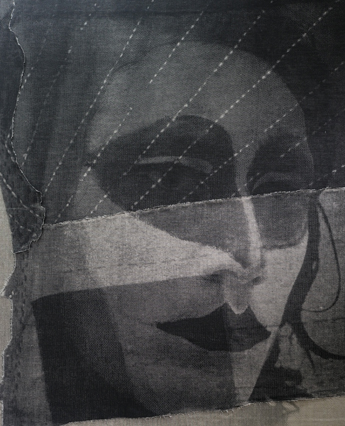
With As if, Carla Arocha – Stéphane Schraenen offer us the double-edged sword that is a frequent feature of their work. The off-hand nonchalance of the title, now a loaded statement in the popular vernacular, might indicate a certain cynicism or world-weariness; a jaundiced eye cast in the direction of art and its efforts. But, like so many other aspects of their work, this is something of an illusion and an allusion.
The title equally refers to the formal and material nature of their new work itself. Within the work of Arocha – Schraenen, simile and facsimile are often content; the nature of an image and its similarity or distance from the perception of that image. In the works that play with layering and blurring the lines between what is, in reality, a solid surface and what is only a reflection –or the facsimile of a tangible material – Arocha – Schraenen join the dotted lines between Modernism’s approach to something nearing an abstracted form of representation and the age old mimetic thrust of art drawing upon observations of the world around us.
In As if this intersection between science and art’s mimetic drives is once again foregrounded. Each work is actually a moiré of one form or another, whether manifesting as a sculpture or photographic work. Most immediately associated with textiles, a moiré is also a scientific phenomenon: an interference created when two grids are superimposed at an angle or where their mesh sizes differ. The nature of the moiré phenomenon connects textile traditions with the photographic and reprographic process and naturally lies within Arocha – Schraenen’s explorations of how images are constructed. In this particular case, their interest examines how moirés manifest in static objects transmute into a perception of movement. Yet, the works also conversely evoke a sense of scientifically explained moirés that occur when an image-making device – for example a television camera- attempts to transmit an image of certain patterned static objects due to the sampling limitations of the medium itself. Just as an image may prove illusory, these works remind us more specifically that one way in which an image might prove to be different from its perception is in terms of movement. Exactly what is moving and what is still within each situation?
– Text excerpted from essay by Ken Pratt
Carla Arocha (Venezuelan, born Caracas 1961, lives Antwerp, Belgium) and Stéphane Schraenen (Belgian, born 1971, lives Antwerp, Belgium) began collaborating publically in 2007 with their exhibition Mauraders at moniquemeloche. Previously, Arocha has had solo exhibitions at moniquemeloche in 2004 and 2001. In 2009 Carla Arocha – Stéphane Schraenen permanently installed the City of Chicago commissioned artwork 24/7 at the CTA’s Red Line Howard Station. The artists have had solo exhibitions at the FRAC Auvergne in Clermont-Ferrand, France, the Kunsthalle Bern in Switzerland, and the MUHKA in Antwerp, Belgium and have work in a number of prestigious institutions including the Art Institute of Chicago, IL; the F.R.A.C. Auvergne, Clermont-Ferrand, France; the Fundación Banco Mercantil, Caracas, Venezuela; the Museum of Contemporary Art, Chicago; the Museum of Modern Art, NY; the Museum van Hedendaagse Kunst Antwerpen (MUHKA), Antwerp, Belgium; and the Stiftung, Bern, Switzerland.