Tag: IMO
Louise Despont // The Directory
Luis Jacob @ IMO

Studio visit // Jan S. Hansen
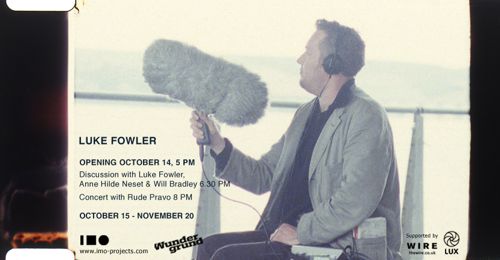
Luke Fowler / Concert with Rude Pravo
Ferdinand Ahm Krag
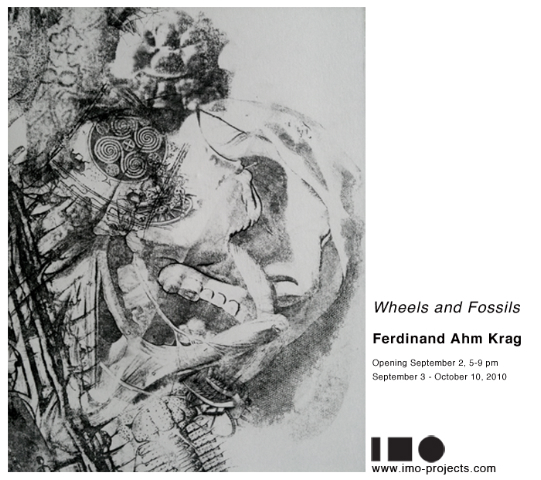
For the exhibition Wheels and Fossils on IMO Ferdinand Ahm Krag presents around twenty paintings, drawings and objects made in the period 2005-2010. Some smaller drawings have been five years in the making, while other and larger works were made just recently. Ahm Krag has also worked with a new type of irregular image that is made by beating standard MDF pieces.
The exhibition presents two video sequences with the title “How to construct a face, how to make an expression’. One video shows history’s first computer animated face created by Frederick Parke at the University of Utah in 1972. The second video is a clip from the television series ‘Cosmos’ (1980), written and narrated by astronomer Carl Sagan. The video presents a re-enactment of an ancient Japanese legend. In an old myth it is explained to us why Japan has a certain crab species, whose shield ‘represents’ a face. And not just any face, but the exact face of an angry samurai warrior. At the end of the sequence, Carl Sagan reveals the ‘natural’ explanation to this face: the face has slowly been exposed onto the crab shell throughout the past 900 years through the mechanism of what Charles Darwin called ‘artificial selection’. Ferdinand Ahm Krag has included the videos based on two reoccurring themes in his drawings and paintings. One of theme could be termed ‘THE PROBLEM OF THE FACE’ – How do you get one? How do you get rid of it again? How do you live with it? How do you live without it? The second theme relates to our dubious notions of artificial and natural. It is Ferdinand Ahm Krags point that our conceptual apparatus around “artificial” and “natural” sometimes prevents us from experiencing nature, where it really is.
Ferdinand Ahm Krag also shows a series of acetone prints consisting of motifs from natural history and cultural history. They are based on the perception of ‘images’ as organisms that live and die, and therefore create fossils to be deposited in sediment layers of images. Ahm Krag is influenced by the idea that these sediment layers of images have been blown to smithereens and rotate in an enormous cloud that has been captured by a new star after the death of the sun. Image fragments cluster in so-called ‘planetesimals’ – the forerunner of a planet. Here the image material creates a so-called ‘PRIMARY CRUST’ – the first crust of the new exo-body.
About his method Ferdinand Ahm Krag states: “When you make images from such fabulous grounds, as the above, the bottom line in the conceptual bookkeeping doesn’t add up. But figures rarely add up at all when dealing with fantasies. The idea is to move beyond the bookkeeping and find new concepts there.”
Ferdinand Ahm Krag graduated from The Royal Danish Academy of Fine Arts in 2006. He has been nominated for the Carnegie Art Award 2008 and was awarded the Arken Museum of Modern Arts travel grant in 2010. He has participated in numerous museum shows. In 2011 Ferdinand Ahm Krag will have his first solo museum show at Esbjerg Kunstmuseum.
Miki Yui
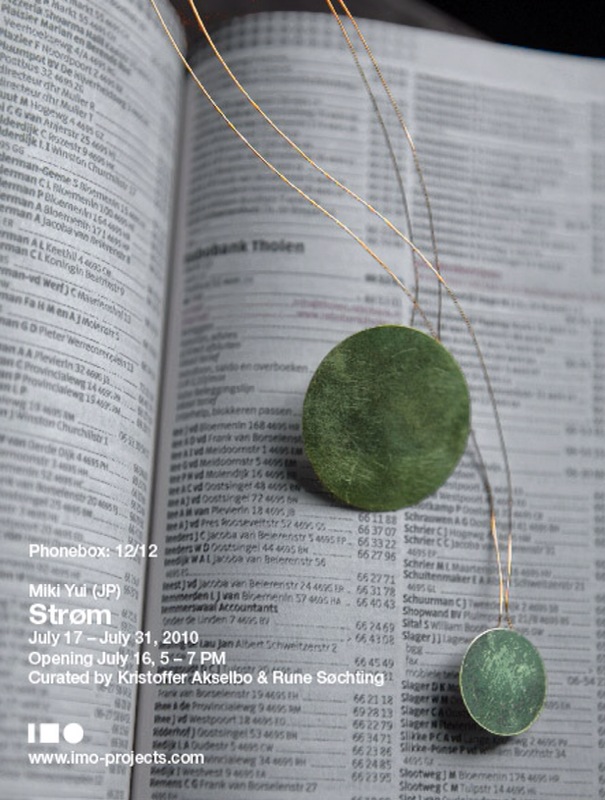
July 16 Japanese artist Miki Yui presents her brand new work Strøm made for the exhibition space Phonebox at the artist-run gallery IMO. Phonebox is located in a phone cabin, which now serves as an intimate exhibition space with room for only one person at a time.
In Miki Yui’s work Strøm Phonebox becomes a unique place that is auditively connected to remote locations. The Danish word Strøm used in the title refers to the electrical nature of the telephone technology as well as an idea of sound as something streaming. The audience steps into a stream of sounds that likewise seem to flow into the phonebox. This happens due to speakers installed in the phonebox and special piezzo speaker-elements mounted on the pages of an old phonebook. The pages are set in motion so as to function as sound-emitting membranes.
Miki Yui is a Japanese artist based in Düsseldorf. In her work she investigates what she calls “small sounds”. Small sounds are sounds that result from minimal movements in the periphery of our auditory experience. Miki Yui’s work – whether it be large scale installations or audio-works on CD – combines the fragile and fluctuating with the concrete and tactile. She has recently developed the “acoustic survival kit 01” with artist Felix Hahn, which is a media body suit with built-in piezzo-speakers that generate sound. Whereas other media-suits used in virtual reality isolates the user from his or her surroundings, the survival kit connects its user through small speakers to his or her immediate environment. In this way her work calls attention to otherwise imperceptible “small” sounds and movements so as to connect the body to the world.
Miki Yui’s work is the last in a series of 12 sound-based works presented in Phonebox at IMO in the first half of 2010. The series is titled Sounds Up Close #1-12 and is curated by Kristoffer Akselbo and Rune Søchting. It is the intention of the series to present a number of important artists who work with sound as medium. The series reflects a number of different approaches to sound. Over a period of six months a total of twelve pieces have been presented each for a fortnight. Earlier artists presented in Phonebox are Stephen Vitiello (US), Ursula Nistrup (DK), Ultra-red (US), Jio Shimizu (JP), Camille Norment (US/N), Morten Skrøder Lund (DK), Aeron Bergman and Alejandra Salinas (US/ES), Marc Behrens (DE), Dani Gal (IL), Steve Roden (US) and Don Ritter (CA).
Phonebox has earlier served as a phone cabin for the employees at Carlsberg. During the last six months the space, which is acoustically isolated, has been functioning as a unique frame for display and reception of sound-based works. Moreover, the space itself has played an important role in the conceptions of many of the presented works.
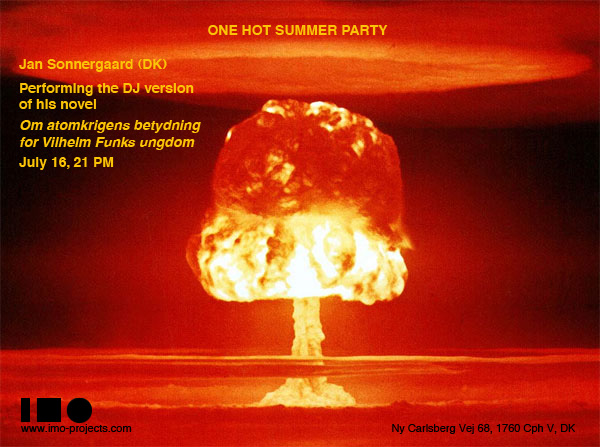
One Hot Summer Party //
Steve Roden
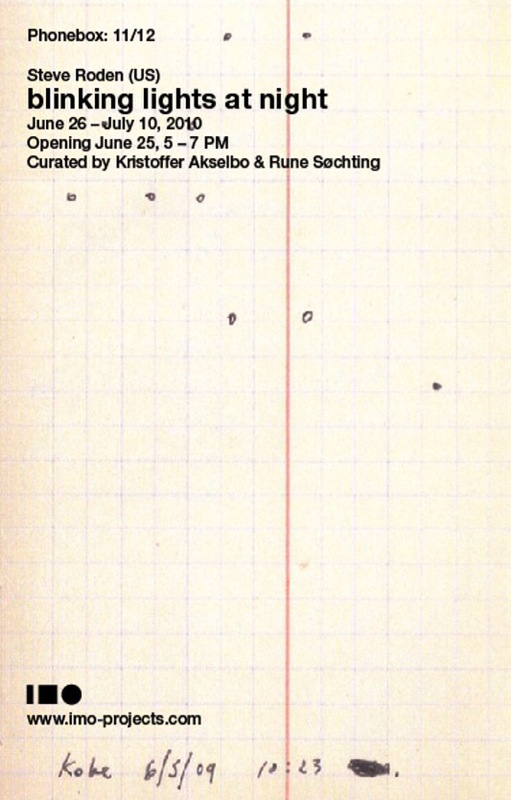
American artist Steve Roden presents his brand new work blinking lights at night made for the exhibition space Phonebox at the artist-run gallery IMO. Phonebox is located in a phone cabin, which now serves as an intimate exhibition space with room for only one person at a time. Here the public is invited to experience the sound work blinking lights at night June 26 – July 10.
Blinking lights at night by Steve Roden takes as its theme a view over Kobe, Japan, from a balcony which the artist has been visiting for almost 20 years. The rythm of blinking lights in the urban nightscape is transformed into a kind of visual and spatial score for a composition. The sound piece takes as its starting point small ‘beep’ sounds made by Roden while contemplating the «silent music» of the lights. The new work made especially for Phonebox is accompanied by a text written by the artist:
…because i have always experienced the view alone and in relative darkness, i began to think about how this outside visual experience at night might be able to converse with an inside audible experience in a small dark private space. Listening to my voice, i replicated each of the light rhythms on an old glockenspiel, and layered the recordings so that the relationship of the notes would resemble that of the field of blinking lights. I decided to present it as a 7” record because such an object needs to be activated by a visitor, as if one were opening a door to step inside, and closing it upon returning to the outside…
The work of Steve Roden, based in Los Angeles, spans various media. Roden’s work integrates various forms of specific notation (words, musical scores, maps, etc.) translated through invented systems into scores which in turn inspire the production of painting, drawing, sculpture, and sound composition. The scores are dictated by rigid parameters and rules though also full of cracks and holes that give way to intuitive decisions and left turns. The inspirational source material becomes a kind of formal skeleton that the abstract finished works are built upon.
Roden has among others exhibited at Centre Georges Pompidou, Paris, and UCLA Hammer Museum, Los Angeles, and performed and played at Serpentine Gallery, London, SFMOMA, San Francisco and The Walker Art Center, Minneapolis
Steve Roden’s work is the eleventh in a series of 12 sound-based works presented in Phonebox at IMO in the first half of 2010. The series is titled Sounds Up Close #1-12 and is curated by Kristoffer Akselbo and Rune Søchting. It is the intention of the series to present a number of important artists who work with sound as medium. The series reflects a number of different approaches to sound. Over a period of six months a total of twelve pieces will be presented each for a fortnight. The final artists in Phonebox is the Japanese artist Miki Yui (JP).
Phonebox has earlier served as a phone cabin for the employees at Carlsberg. During the next six months the space, which is acoustically isolated, will function as a unique frame for display and reception of sound-based works. Moreover, the space itself will play an important role in the conceptions of many of the presented works.