Matt Stokes

braskart

ZieherSmith presents the New York debut of these are the days (2009), a film installation by British artist Matt Stokes originally commissioned by Arthouse, Austin, Texas, and the launch of the accompanying catalogue designed by British collective, Abake. Inspired by punk rock subcultures, these are the days is the artist’s first institutional commission in the United States.

In 2007, Arthouse invited Stokes to create a new film project with ZieherSmith acting as co-producer. these are the days is the result of Stokes’ close work with communities connected to Austin’s music scene and his extensive research into anti-establishment musical genres, particularly punk rock. Investigating the dichotomies expressed within earlier and later punk communities, his research ultimately led to the creation of the dual channel film installation, an archival installation exhibition exclusively at Arthouse, and the publication about both.

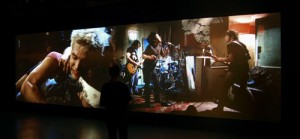
The first film features footage from a specially organized punk show, staged by Stokes, at the Broken Neck, an alternative venue in Austin and filmed by renowned cinematographers Lee Daniel and P.J. Raval. The second film, created in response at a recording session at Austin’s Sweatbox Studios, depicts a makeshift band’s musical reaction to the event footage. A reversal of roles between audience and performers, the work examines the concepts of inspiration and response. Punk as it was then and as it is now, different yet the same–these are the days.

Matt Stokes’ artistic practice is marked by anthropological enquiry and an interest in happenings or informal movements that bind people together. Taking a variety of forms — from organizing events and assembling archives to making films and creating sculptural installation — Stokes’ works are often collaborative in nature and sometimes take place outside the traditional gallery space. Music subcultures have been central to the development of his most recent projects, which have focused on their ability to shape lifestyle, beliefs and create community. Northern Soul, acid/house and black metal are among the genres of music he has explored, poetically revealing music’s intrinsic ability to create fellowship through devotion or the quasi-religious experience of dance.

these are the days was first presented in 2009 at Arthouse and at 176 / Zabludowicz Collection, a major new contemporary art space located in London. The London show also featured The Gainsborough Packet (2009, co-commissioned by 176 and the Baltic Centre for Contemporary Art), which will screen in the back room of ZieherSmith. An editioned dubplate featuring music from both these are the days and The Gainsborough Packet is also available. The Abake-designed catalogue will be first released at the opening and includes documentation of both the film piece and of ephemera from the 1970s and 1980s related to the punk, post-punk, and DIY movements in Austin, material that was presented as an ambiguous archive at Arthouse.

Matt Stokes was born in 1973 in Penzance, England and currently lives in Gateshead, England. He is the 2006 recipient of the esteemed Beck’s Futures Prize, awarded by the ICA, London and is currently on the shortlist for the 2009 Northern Art Prize. In 2009, he was also included in solo and group exhibitions at the Baltic Centre of Contemporary Art, Newcastle, and the Lentos Museum, Linz, Austria, among other venues. Special thanks to Arthouse, the Arts Council England, Michael A. Chesser, Johnna and Stephen Jones, and Julie and John Thornton.

ZieherSmith

Sean Kennedy @ Jancar Jones Gallery

53_kennedyweb

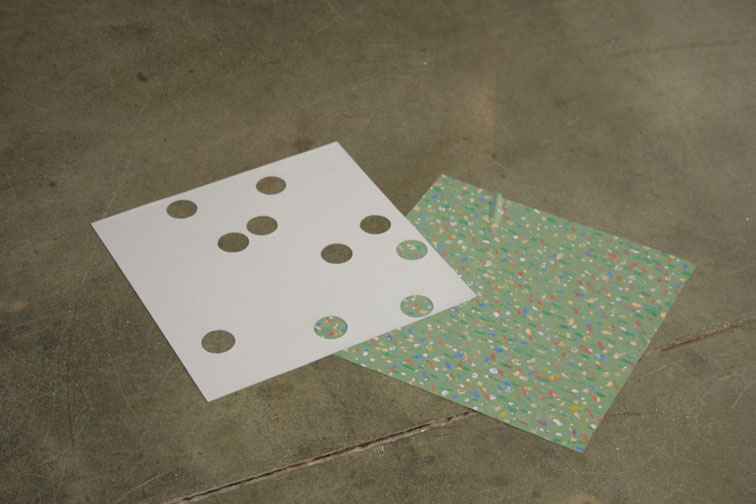
The Jancar Jones Gallery is pleased to announce an exhibit of work by Los Angeles-based artist Sean Kennedy. The exhibit will include a new body of work comprised of 12 x 12 inch tiles, made of uniformly poured latex paint, and wall mounted suede paintings.

Through a reinvestment of paint with illusionism, the tiles (which serve as receptacles for a variety of painted abstract marks) posit non-objective abstraction as something capable of fluctuation between the supposedly respective realms of high art and commercial design.  In this context, the assimilability of certain forms seems to have been prefigured by their lack of representation.  In juxtaposition with the suede paintings, whose surfaces might bear traces of similar patterns, these forms are meant to seem highly disposable.

Jancar Jones Gallery

Simon Denny: “Celebrities’ Houses at Night: A Projection”

braskart2braskart1

SIMON DENNY: “CELEBRITIES’ HOUSES AT NIGHT: A PROJECTION”

13.11.-13.12.2009 / PREVIEW: 13.11.2009 / 19.00-21.00


—–

EDITOR: “Look, kid, you got a nice idea, with the house thing, it’s just not something I can get behind, alright?”

WILL SMITH: “Ok, ok, alright – see ‘cos you not lettin’ your cerebellum rotate man. Listen, look at this: It’s not just pictures, I wrote little stories with them too! B-blam! Ahh! You didn’t notice that one, right? See? It’s different now, see, cos I’m not just a photographer, man, I’m photographer and a writer – I’m ambidextrous”(i)


“Every spectator of a television mystery knows with absolute certainty how it is going to end. Tension is but superficially maintained and is unlikely to have a serious effect any more. On the contrary, the spectator feels on safe ground all the time… Everything somehow appears ‘predestined’.”(ii)


“Mass culture, if not sophisticated, must at least be up to date.”(iii)

For his exhibition at STANDARD (OSLO) Simon Denny will again focus on reviving an understanding of television as a material object. The reconsideration of the traditionally opposed fields of broadcast television art and video practice1will again pitted against each other. On top of this, an attempt to spotlight the advance of display technology in exhibitions will bring together the LCD monitor and the digital projector in a retrograde, positivist gesture. This time taking his cue from the content of the international hit television show “The Prince of Bel-Air” and feeding it through the filter of the in-progress event of the show’s reissue – season-by-season, as boxed set DVDs – Denny will project on the anticipation of the delayed release and production-to-shelf-materialization of the series’ final two seasons and link the gradual physical thinning of the box-sets’ packaging to the receding perceived differences between digital images and physical objects, content production and commodity production, LCD monitor and digital projector.

Following a close reading of Adorno’s classic “How to Look at Television”, the project will interpret genre guidelines of the medium, presenting a characteristically up-to-the-minute-looking mystery show consisting of “various layers of meanings superimposed on one another, all of which contribute to the effect”2. The final presentation of this multimedia rehash will resemble the style of other exhibitions, everything somehow seeming ultimately ‘predestined’3. Just as the radio listener who catches the beginning of Tschaikovsky’s Piano Concerto as a theme song, knows automatically, ‘aha, serious music!’ or, when he hears organ music, responds equally automatically, ‘aha, religion!’ viewers will approach Denny’s show with the phrase ‘aha, video installation’.4

Denny will frame the exhibition around the expanded-marketing group Omni Consumer Products’ practice of what they call ‘de-fictionalising’5 from the screen, such as “True Blood”’s drink “Tru Blood”, manufactured by the company in collaboration with the series’ second season release. The exhibition will aim at a similar effect, admiring the clarity of this reality blurring gesture. “Due to their calculative nature, these rationalized products seem to be…clear- cut in their meaning…[and are, in a way, able to be]…boiled down to [an] unmistakable ‘message’.”6

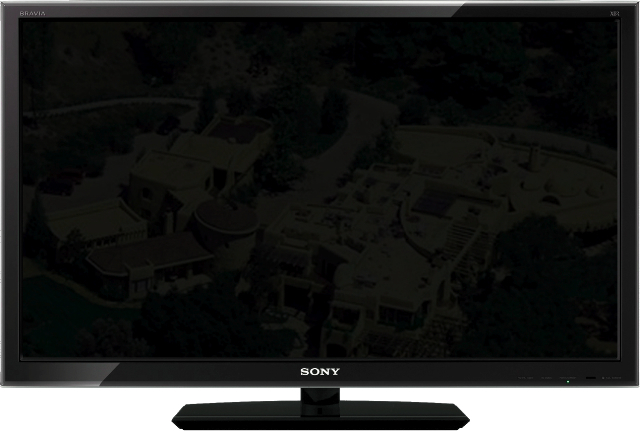
From an episode of the as-yet-not-re-released 5thseason of the Fresh Prince7, Denny ‘de-fictionalises’ an idea for a coffee-table book that Will Smith dreams up to impress his girlfriend. “Celebrities’ Houses At Night” is a series of photographs taken by Smith of Bel-Air Celebrities’ abodes that, although intended for book publication, never makes it into page form. Uncannily resembling canonical moments in west coast conceptual photographic and book making practice such as Ed Ruscha’s “26 Gasoline Stations”, Celebrities’ Houses At Night is a never-to-be-realized book of serial photography, with its inception in a TV show, and its realization as a pile of photographs. Denny “broadcasts” this idea to Oslo, in a re-run that anticipates a re-release, in a transmission that takes the form of a physical product, in a blurring of contemporary moving image display formats, in a projection of marketing that uses only the distribution available to a gallery.

“The entertainment business was a distribution business, in other words people who controlled pathways to people’s eyeballs, where they sat in the movie theatre or how they got cable, those people controlled the media business…What makes the Internet a radical game changer is that it makes distribution a commodity – in other words, anybody can have a pathway to an eyeball – marketing becomes more important but distribution is almost trivial.”

Standard

Lilibeth Cuenca Rasmussen

091028performa-4

Lilibeth Cuenca Rasmussen: The Present Doesn’t Exist in My Mind and the Future is Already Far Behind
at Performance Project @ University Settlement

A one-woman performance inspired by the writings of Valentine de Saint-Point and Mina Loy that reflects on lust, romanticized sexuality, and the subjugation of women. Collaborating with composers Pete Drungle and Brian Bender, motion graphic artist Brian Close, and costume designer Lise Klitten, Cuenca Rasmussen merges choreography, song, architecture and costume in a multi-media performance.

Lilibeth Cuenca Rasmussen (b. Manila, Philippines, 1970) works primarily in video and performance to explore notions of gender, national identity, and social relations. Her Danish-Filipino background often serves as a point of departure for work. She is a graduate of The Royal Danish Academy of Fine Arts, and a 2004 recipient of the Danish Art Council’s three-year grant. Her work has been presented both in the United States and internationally at institutions such as U-Turn Quadriennial, Copenhagen; Brooklyn Museum, New York; Malmö Kunst Museum, Sweden; the Museum of Contemporary Art, Seoul, South Korea and Praxis: Art in Times of Uncertainty, Biennale of Contemporary Art, Thessaloniki.

SculptureCenter

Yoko d’Holbachie / London Miles Relocation

140

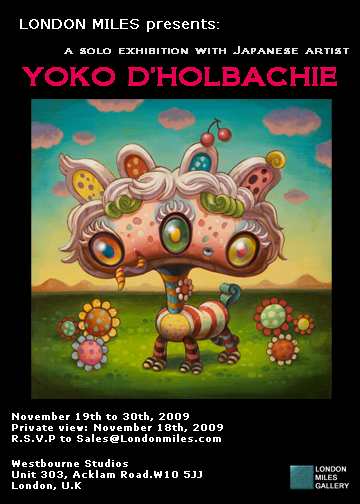
Living in Your Dreams features Yoko’s largest body of solo work to exhibited. This new collection aims to interrupt the meaning of dreams, and the spirits that journey through our subconscious. At first glance the viewer is faced with colourful and strange creatures wondering in a neon world, yet hidden under her externally pleasantly painted lands lays something dark and mysterious.

The cartoon like figures of animals and children appear as a cross between Japanese anime and western pop icons are painted with a truly diverse range of colours. With a sharp attention to detail, a quality that makes her paintings stand out  Yoko d’Holbachie demands your attention as she takes you on a 21st century psychedelic journey into dreams. Once you see any of her works, you will never forget them due her unique interpretation of the world and the strange creatures she creates.

Since early 2005 Yoko’s paintings have been exhibited in galleries in Asia, America and parts of Europe, creating new fans and admires where ever her work is showcased.  Yoko’s  work has been used for Album cover designs, Magazine covers and computer games. She was featured on the cover of Hi-Fructose magazine in their VI issue.

London Miles